


rhythm apparatus
Datecirca 1903
Inventory NumberWJ0112
ClassificationAcoustic Instrument
Subject
Maker
H. Sumner
User
Robert MacDougall
1866 - 1939
Cultural Region
Place of Origin
Dimensions34 x 65 x 43 cm, 33 lb. (13 3/8 x 25 9/16 x 16 15/16 in., 15 kg)
pulley wheel: 12.5 cm (4 15/16 in.)
pulley wheel: 12.5 cm (4 15/16 in.)
Material
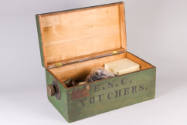
Accessorieswooden disks (41); steel and brass fittings; wooden box for storing accessories
DescriptionA device consisting of four parallel metallic shafts mounted on two pairs of metallic stands on a wooden base. Three shafts share one pair of stands while the fourth has a pair for itself.
The thicker shaft on the shared stands holds the bases of fifteen numbered hammers at regular intervals which extend across to the shaft on the other stands. On that shaft, the hammer heads slide on wooden disks that gradually increase in diameter until they suddendly end in a gap with a metallic anvil. This is the only shaft with a mechanism that allows it to rotate and can be connected to a motor by a pulley wheel.
A third shaft, connected to the same stands as the hammer bases, has vertical holders for each hammer so they can be lowered and raised simultaneously from the disks they are sliding on. The fourth shaft is simply the axis on which this lowering mechanism rotates.
The thicker shaft on the shared stands holds the bases of fifteen numbered hammers at regular intervals which extend across to the shaft on the other stands. On that shaft, the hammer heads slide on wooden disks that gradually increase in diameter until they suddendly end in a gap with a metallic anvil. This is the only shaft with a mechanism that allows it to rotate and can be connected to a motor by a pulley wheel.
A third shaft, connected to the same stands as the hammer bases, has vertical holders for each hammer so they can be lowered and raised simultaneously from the disks they are sliding on. The fourth shaft is simply the axis on which this lowering mechanism rotates.
Signedstamped on wooden base: H. SUMNER / CAMB. MASS.
FunctionThis is an instrument that was designed for studying the perception of rythm in people. The intention was to eliminate all other aspects of music such as varying tones and a recognizable melody. The way to accomplish this is to have a set of identical hammers that can be made to fall at set intervals and from varying heights.
The hammers are held in a horizontal position by their bases being attached to a shaft parallel to the rotating one. Their heads slide on rotating wooden disks that increase in diameter to suddenly end in a gap with a metallic anvil, so the hammer produces a sound by hitting it. There are many disks with different diameters to choose from so that the loudness can be varied, and they can be rotated to any angle, controlling the exact moment in a cycle when the hammer hits the anvil. Since there are fifteen hammers, the rythmic sounds that are produced can be very complex, and the purpose of the instrument was precisely to test the limits of the perception of rythm.
The hammers can be raised and lowered simultaneously so that the motor can be set in motion and stabilized before the experiment begins.
An extensive description of this instrument as well as the results of research conducted with it can be found in Robert McDougall's "The Structure of Simple Rhythm Forms" article available online at Project Gutenberg here.
The hammers are held in a horizontal position by their bases being attached to a shaft parallel to the rotating one. Their heads slide on rotating wooden disks that increase in diameter to suddenly end in a gap with a metallic anvil, so the hammer produces a sound by hitting it. There are many disks with different diameters to choose from so that the loudness can be varied, and they can be rotated to any angle, controlling the exact moment in a cycle when the hammer hits the anvil. Since there are fifteen hammers, the rythmic sounds that are produced can be very complex, and the purpose of the instrument was precisely to test the limits of the perception of rythm.
The hammers can be raised and lowered simultaneously so that the motor can be set in motion and stabilized before the experiment begins.
An extensive description of this instrument as well as the results of research conducted with it can be found in Robert McDougall's "The Structure of Simple Rhythm Forms" article available online at Project Gutenberg here.
ProvenanceFrom the Department of Psychology, Harvard University.

Department of Physics, Harvard University
Date: mid 20th-late 20th Century
Accessories: five odd knobs, each with some sort of arrow showing which way it is pointing
Object number: 2004-1-0408g




Date: 1890-1930
Object number: RS1425a


Department of Physics, Harvard University
Date: mid 20th-late 20th Century
Accessories: variety of spare parts cataloged as 2004-1-0408c-g
Object number: 2004-1-0408a
