


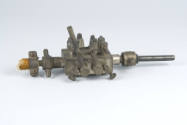
counting mechanism
Date1850-1900
Inventory Number1998-1-0154
ClassificationCounting mechanism
Maker
American
?
Cultural Region
Dimensions7.1 × 13.6 × 7 cm (2 13/16 × 5 3/8 × 2 3/4 in.)
Material
DescriptionSmall counting mechanism with two dials on silvered dial plate, one divided into 100 parts, the other into 25 parts
This object consists of a base, on which a thin hollow metal box containing gears is mounted. The flat rectangular metal base has a hole on each of the two sides of the box and two holes behind the back. Presumably these holes allow the user to affix the entire object atop a stand or table. The base provides the bottom side to the box, however it is wide and long enough to extend past the box in every direction. The effect, a built-in metal perimeter, provides a high degree of stability.
The four sides of the box are attached with long metal screws, one in each corner of the box's front. The screws are enveloped inside the box by curved metal sheets attached to the sides. As well, there are two additional screw-like joiners whose shafts run from the front of the box, through the middle of its hollow cavity, and into its back side.
The back side of the box features a large hole in the center. Perpendicularly out of this hole juts a thick metal protrusion, seemingly for attachment to a crank or other rotating mechanism(s).
This object consists of a base, on which a thin hollow metal box containing gears is mounted. The flat rectangular metal base has a hole on each of the two sides of the box and two holes behind the back. Presumably these holes allow the user to affix the entire object atop a stand or table. The base provides the bottom side to the box, however it is wide and long enough to extend past the box in every direction. The effect, a built-in metal perimeter, provides a high degree of stability.
The four sides of the box are attached with long metal screws, one in each corner of the box's front. The screws are enveloped inside the box by curved metal sheets attached to the sides. As well, there are two additional screw-like joiners whose shafts run from the front of the box, through the middle of its hollow cavity, and into its back side.
The back side of the box features a large hole in the center. Perpendicularly out of this hole juts a thick metal protrusion, seemingly for attachment to a crank or other rotating mechanism(s).
Signedunsigned
FunctionPresumably, a crank or other kind of rotating mechanism would be attached to the back side of the box, and by reading the face, one would be able to count the number of rotations made.

Richard W. Thomas
Date: circa 1861
Accessories: bottle and beaker (1998-1-1634a); hydrometer and manual (1998-1-1634b)
Object number: 1998-1-1634

Iomec, Incorporated - Digitronics Division
Date: circa 1974
Accessories: paper punch-tape program stored in a plastic bag with the instrument
Object number: 1998-1-0017

Hammond Typewriter Company
Date: circa 1923
Accessories: four Hammond type shuttles for different type faces, each with a wooden storage box; four laminated paper rectangles with symbol placement guide; instruction book, instruction sheets, advertisements, and correspondence (in object file)
Object number: 1996-1-0373

French
Date: circa 1880
Accessories: protecting case with glass window
Object number: DW0095

Forster
Date: 1950-1960
Accessories: spare ink cartridges; pen attachments
am auxiliary box containing small Allen wrench, scotch tape, extra parts, and storage instructions
Object number: 1999-1-0054

Edison and Swan United Electric Light Company, Ltd.
Date: 1920-1930
Object number: WJ0141a

Edison and Swan United Electric Light Company, Ltd.
Date: 1920-1930
Object number: WJ0141b

Apple Computer Inc.
Date: circa 1990
Accessories: Apple extended keyboard (1999-1-0014b); Apple desktop bus mouse (1999-1-0014c); Allied Telesis Ethernet transceiver (1999-1-0014d )
Object number: 1999-1-0014a


