


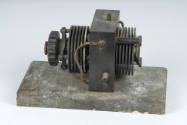
disolving key for oxyhydrogen lights
Datecirca 1885
Inventory Number1996-1-0384
ClassificationValve
Subject
Maker
T.H. McAllister
Cultural Region
Place of Origin
Dimensions9.4 × 26 × 8.8 cm (3 11/16 × 10 1/4 × 3 7/16 in.)
Material
DescriptionA metal rectangular prism. Out of one end emerges a thick threaded cylinder. Screwed onto the top is a large bolt with two stout cylindrical arms. Out of the top of the bolt comes an additional rod leading into a clamp. Fixed inside seems to be a severed portion of what once was an insulated wire. The yellow fabric covers a white woven rubber tube.
Out of the other end emerges a shiny metal cylinder, approximately the same size as the threaded cylinder. From there the diameter of the tube narrows for a segment and then opens back up. From a band around the wide segment emerges a perpendicular metal cylinder. The wide segment continues through a square bolt into a longer narrower hollow rod.
Two of the four sides of the metal rectangular prism (one narrower than the other) feature many protuberances. From the narrower side emerge four stout metal cylinders. Connected to the middle two are the ends of two cylindrical rods, one longer than the other; these rods are connected by two parallel narrow strips, affixed with screws, forming a kind of lever. The two outer stout metal cylinders from the narrower side have running through them tightening screws, seemingly to allow the user to restrict the range of the lever. Each of these two cylinders features the number '5' on top (upside down in the photograph).
Out of the broader side of the metal rectangular prism emerge eight more metal cylinders. The four of these cylinders in the middle are topped by vaguely conical metal pieces with small holes on top; these are likely valves. The others, each next to one of the valves, feature small metal rods running through them that are unconnected to anything else; these, which can be turned, presumably regulate the valves.
Out of the other end emerges a shiny metal cylinder, approximately the same size as the threaded cylinder. From there the diameter of the tube narrows for a segment and then opens back up. From a band around the wide segment emerges a perpendicular metal cylinder. The wide segment continues through a square bolt into a longer narrower hollow rod.
Two of the four sides of the metal rectangular prism (one narrower than the other) feature many protuberances. From the narrower side emerge four stout metal cylinders. Connected to the middle two are the ends of two cylindrical rods, one longer than the other; these rods are connected by two parallel narrow strips, affixed with screws, forming a kind of lever. The two outer stout metal cylinders from the narrower side have running through them tightening screws, seemingly to allow the user to restrict the range of the lever. Each of these two cylinders features the number '5' on top (upside down in the photograph).
Out of the broader side of the metal rectangular prism emerge eight more metal cylinders. The four of these cylinders in the middle are topped by vaguely conical metal pieces with small holes on top; these are likely valves. The others, each next to one of the valves, feature small metal rods running through them that are unconnected to anything else; these, which can be turned, presumably regulate the valves.
Signedon back, stamped in tiny letters: McALLISTER
Inscribedon back, stamped, underneath the arch: NEW YORK
on back, stamped: PATENTED NOV.10.1885 / No. 225
FunctionThis valve was used to divide gas flowing through a tube into as many as five different tubes. It was especially designed to mix oxygen and hydrogen gases, which produced light.
All the information can be found in the patent granted in 1885, which can be read here.
All the information can be found in the patent granted in 1885, which can be read here.
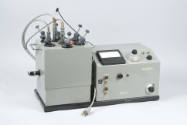


American
Date: 1870-1930
Accessories: small rubber hose; tiny metal clamp-like component
Object number: 1996-1-0426


Charles-Louis Chevalier
Date: circa 1820
Accessories: (b) glass cup (stored separately on same shelf); (c) long, Y-shaped brass tube (tied to pump)
Object number: DW0822a-c


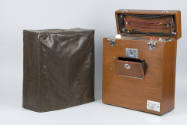
Sanborn Company
Date: 1930-1945
Accessories: leather cover; cloth cover; thin red wire
Object number: 1996-1-0278

Iomec, Incorporated - Digitronics Division
Date: circa 1974
Accessories: paper punch-tape program stored in a plastic bag with the instrument
Object number: 1998-1-0017