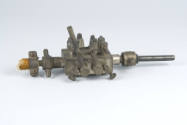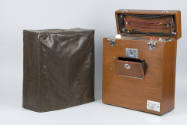

cardioscope
Date1930-1945
Inventory Number1996-1-0278
ClassificationCardioscope
Subject
Maker
Sanborn Company
1917 - 1961
User
Howard B. Sprague
1895 - 1970
User
Massachusetts General Hospital
1811-present
Cultural Region
Place of Origin
Dimensions51 × 37.5 × 7 cm (20 1/16 × 14 3/4 × 2 3/4 in.)
Material
Accessoriesleather cover; cloth cover; thin red wire
DescriptionA wooden rectangular prism with rounded edges, the longest side of which functions as the vertical axis. In the bottom right corner of the front side, a small metal plaque bearing the user's name: "HOWARD B SPRAGUE M.D. / BOSTON, MASS. / INST NO 1"
In the middle of the front side of the instrument is a panel, the bottom of which is hinged so as to allow the top to be pulled out slightly. Above this panel is a small rectangular metal plate with a small meshed hole in the middle.
The top of the instrument is generally kept shut by two metal clasps when not in use. When the lid is opened (there are hinges at the back), one can see that the bottom side of the lid features six shiny and thick metal hooks, around which are coiled three different wires. The wire wrapped around the middle pair of hooks is thin and red; the other two, wrapped around the perimeter of the lid, are thick and black. Each of the latter wires emerges from the control panel, which was also revealed when the lid was lifted.
The control panel is a rectangular metal plate embossed to look like it is haphazardly made from wicker. The two wires described above emerge from the two top corners of the control panel. On the left, one is marked "INPUT". On the right, the other (a power cable) is marked "110V.60CYC".
The right side of the control panel features two white knobs, shaped like talons that are bulbous in the middle, labeled "SENSITIVITY" and "BEAM". The middle features the long black nameplate, under which there is another smaller plate which reads: "DEVELOPED BY / GRAHAM ASHER, M.D. / FRANK HOECKER, Ph. D. / PATENT PENDING". On the left side of the control panel are two buttons, labeled "INTENSIFIER", and "TIMER" with a switch between them labeled "MOTOR". Above these is a white indicator light. Next to that is a small black cylinder labeled "FUSE".
Underneath the fuse is a small raised hole, which presumably is where the user would slot in one end of another thin red wire which is part of the apparatus.
The entire apparatus has both a leather cover and a cloth cover.
In the middle of the front side of the instrument is a panel, the bottom of which is hinged so as to allow the top to be pulled out slightly. Above this panel is a small rectangular metal plate with a small meshed hole in the middle.
The top of the instrument is generally kept shut by two metal clasps when not in use. When the lid is opened (there are hinges at the back), one can see that the bottom side of the lid features six shiny and thick metal hooks, around which are coiled three different wires. The wire wrapped around the middle pair of hooks is thin and red; the other two, wrapped around the perimeter of the lid, are thick and black. Each of the latter wires emerges from the control panel, which was also revealed when the lid was lifted.
The control panel is a rectangular metal plate embossed to look like it is haphazardly made from wicker. The two wires described above emerge from the two top corners of the control panel. On the left, one is marked "INPUT". On the right, the other (a power cable) is marked "110V.60CYC".
The right side of the control panel features two white knobs, shaped like talons that are bulbous in the middle, labeled "SENSITIVITY" and "BEAM". The middle features the long black nameplate, under which there is another smaller plate which reads: "DEVELOPED BY / GRAHAM ASHER, M.D. / FRANK HOECKER, Ph. D. / PATENT PENDING". On the left side of the control panel are two buttons, labeled "INTENSIFIER", and "TIMER" with a switch between them labeled "MOTOR". Above these is a white indicator light. Next to that is a small black cylinder labeled "FUSE".
Underneath the fuse is a small raised hole, which presumably is where the user would slot in one end of another thin red wire which is part of the apparatus.
The entire apparatus has both a leather cover and a cloth cover.
Signedin middle of control panel: SANBORN Cardioscope
Inscribedin middle of control panel: DEVELOPED BY / GRAHAM ASHER, M. D. / FRANK HOECKER, Ph.D. / PATENT PENDING
FunctionThe Sanborn cardioscope was one of the first portable instruments that allowed its user to assess a heart rate's waveform.


Hammond Typewriter Company
Date: circa 1923
Accessories: four Hammond type shuttles for different type faces, each with a wooden storage box; four laminated paper rectangles with symbol placement guide; instruction book, instruction sheets, advertisements, and correspondence (in object file)
Object number: 1996-1-0373
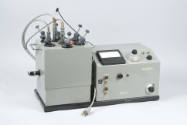
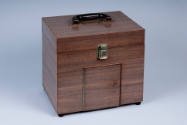
Beckman Instruments, Inc.
Date: circa 1955
Accessories: instructions attached to underside of box lid
Object number: 1996-1-0276


Richard Frères
Date: circa 1886
Accessories: small wooden box; ink; droppers
Object number: 1996-1-0154