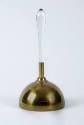
Faraday cage
Dateca. 1850-1880
Inventory NumberDW0410
ClassificationFaraday Cage
Subject
Cultural Region
Place of Origin
Dimensions83 × 26 × 26 cm (32 11/16 × 10 1/4 × 10 1/4 in.)
Material
DescriptionFrom Instrument Card:
"Electrostatic Cage - Six vertical wires in a circle bent together at the top into a brass fitting with spark point above. No Name. Six stripes in a star constitute the base - threaded brass balls from feet. In center 21" brass tube with paper brush on top end."
"Electrostatic Cage - Six vertical wires in a circle bent together at the top into a brass fitting with spark point above. No Name. Six stripes in a star constitute the base - threaded brass balls from feet. In center 21" brass tube with paper brush on top end."
Signedunsigned
FunctionA Faraday cage is an enclosure formed by conducting material or a mesh of such material. As a result of being surrounded by a conductor, the inside of the cage is at the same electric potential, so no currents (including lightning, electric arcs etc.) will enter it. They are frequently used to protect sensitive equipment from electric discharges. Cars for example are designed to be Faraday cages.
This particular Faraday cage appears to be for demonstration purposes. The paper brush at the end of the pole is a typical indicator of electric charge.
This particular Faraday cage appears to be for demonstration purposes. The paper brush at the end of the pole is a typical indicator of electric charge.
ProvenanceDavid Wheatland purchased from Roux-Devillas Paris, June 6, 1969 (lot 10/3).