


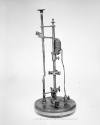
electric arc lamp
Datemid 19th-late 19th Century
Inventory Number0166
ClassificationArc Lamp
Subject
User
Department of Physics, Harvard University
founded 1884
Maker
American
?
Cultural Region
Place of Use
Dimensions35.5 × 16 × 16 cm (14 × 6 5/16 × 6 5/16 in.)
Material
Bibliography
DescriptionAdjoining rods of carbon held in 2 hollow dishes in turn mounted on a brass post also supporting an electro-magnet. Round 3-ply wooden base.
The post holds several fixtures. The first fixture from the bottom is a ring fastened to the post in such a manner that it turns on a horizontal pivot held in place on either side by slotted-head screws. Jutting from the ring is a rod that holds back a spring at the bottom of the carbon holder. Jutting up from the ring is a rectangular piece. A screw in the rod pushes on that piece in order to counter the force of the spring. Adjusting the screw allows the user to adjust the height of the carbon.
The next fixture is a piece with three screws, two on either short side and one on the long side. On the other long side are two holes, possibly for wires.
The next fixture is the electromagnet itself. At its bottom is a screw that keeps it fastened to the post but allows its height to be adjusted. The magnet consists of two solenoids wrapped around iron cores. The wires of both solenoids are thick. Atop the electromagnet is a rectangular piece at the end of two rods that connect to the holder of the top carbon.
The holder of the top carbon is a hollow cylinder connected to the brass post by a brass plate. Toward the bottom of the holder is a pivot that is connected on one side to the rectangle over the magnet and on the other side to a piece with a screw that almost touches the holder.
The holder of the bottom carbon is another hollow cylinder with a track on one side, along which a short rod that is pushed up by a spring and down by a metal rod attached to the bottom fixture on the post.
On the base are three binding posts. One of them is connected to a wire that is wrapped around one of the electromagnets.
The base itself is circular with three layers of wood.
The post holds several fixtures. The first fixture from the bottom is a ring fastened to the post in such a manner that it turns on a horizontal pivot held in place on either side by slotted-head screws. Jutting from the ring is a rod that holds back a spring at the bottom of the carbon holder. Jutting up from the ring is a rectangular piece. A screw in the rod pushes on that piece in order to counter the force of the spring. Adjusting the screw allows the user to adjust the height of the carbon.
The next fixture is a piece with three screws, two on either short side and one on the long side. On the other long side are two holes, possibly for wires.
The next fixture is the electromagnet itself. At its bottom is a screw that keeps it fastened to the post but allows its height to be adjusted. The magnet consists of two solenoids wrapped around iron cores. The wires of both solenoids are thick. Atop the electromagnet is a rectangular piece at the end of two rods that connect to the holder of the top carbon.
The holder of the top carbon is a hollow cylinder connected to the brass post by a brass plate. Toward the bottom of the holder is a pivot that is connected on one side to the rectangle over the magnet and on the other side to a piece with a screw that almost touches the holder.
The holder of the bottom carbon is another hollow cylinder with a track on one side, along which a short rod that is pushed up by a spring and down by a metal rod attached to the bottom fixture on the post.
On the base are three binding posts. One of them is connected to a wire that is wrapped around one of the electromagnets.
The base itself is circular with three layers of wood.
Signedunsigned
Inscribedstamped: 8-22
Curatorial RemarksSee Wormell Catalog 1893 p. 487 fig. 465. Adjoining rods of Carbon held in 2 hollow tubes in turn mounted on a brass post also supporting an electromagnet. Round 3-ply wooden base. Physics old no. 8-22
FunctionThis is a carbon arc lamp in which the distance between the carbon rods is regulated by a system of electromagnets.
According to W. Larden, Electricity for Public Schools and Colleges (London: Longmans, Green, and Co., 1887): "Initially the two carbons, made of hard gas coke or of some other very dense form of carbon, are in contact. When, however, the current is well established, by which time the carbons at the point of contact will have been raised to a very intense white heat, a small electro-magnet that is in the circuit acts upon a lever; and then, by means of a clutch that acts by friction, raises the rod bearing the upper carbon. Thus the carbons are slightly separated and the arc is established. If by the using up of the carbons the space between becomes too great and the current becomes enfeebled, the electro-magnet's hold on the lever and clutch becomes relaxed; and the latter allows the upper carbon rod to slide down nearer to the lower. When the current again rises to its proper value, this slipping movement is checked by means of the electro-magnet. If the arc be entirely broken, it can be restored only by the carbons coming again into actual contact" (438-9).
According to W. Larden, Electricity for Public Schools and Colleges (London: Longmans, Green, and Co., 1887): "Initially the two carbons, made of hard gas coke or of some other very dense form of carbon, are in contact. When, however, the current is well established, by which time the carbons at the point of contact will have been raised to a very intense white heat, a small electro-magnet that is in the circuit acts upon a lever; and then, by means of a clutch that acts by friction, raises the rod bearing the upper carbon. Thus the carbons are slightly separated and the arc is established. If by the using up of the carbons the space between becomes too great and the current becomes enfeebled, the electro-magnet's hold on the lever and clutch becomes relaxed; and the latter allows the upper carbon rod to slide down nearer to the lower. When the current again rises to its proper value, this slipping movement is checked by means of the electro-magnet. If the arc be entirely broken, it can be restored only by the carbons coming again into actual contact" (438-9).
ProvenanceFrom the Physics Department, Harvard University.


Louis Jules Duboscq
Date: 1860-1879, 1882-1885
Object number: 1997-1-0688

Louis Jules Duboscq
Date: 1860-1879, 1882-1885
Object number: 1996-1-0669

Louis Jules Duboscq
Date: 1860-1879, 1882-1885
Object number: 1997-1-0687

W.G. Pye & Company, Ltd.
Date: circa 1920
Accessories: 5 accessory parts:
2 magnetic rods with spherical ends;
one brass notch;
needle with tip inserted into cork;
Object number: 1997-1-0662

Walter Hibbert
Date: early 20th Century
Accessories: 7 accessory parts:
2 magnetic rods with spherical ends;
4 brass notches;
needle with tip inserted into cork;
Object number: 1997-1-0661

Date: 1890-1930
Object number: RS0470


Carl Zeiss Jena
Date: circa 1926
Accessories: wooden box with two hook-and-eye latches to fasten front opening; in instrument file: instruction book (photocopy); Geissler tube labeled "H2"; carboard tube containing German thermometer C in stainless steel holder that screws into instrument; glass bottle with cork stopper labeled "Monobromnaphthalin, Germany nD=1 658"; small round cardboard box labeled "For Pulfrich Refractometer" containing one tubulure
Object number: 1996-1-0229


F. F. Metzger
Date: 1905-1930
Accessories: steel contact points (4);
strain gauges (2);
square bars (2);
dial gauge
Object number: 1999-1-0083

Burnell Telephone and Electric Company
Date: circa 1905
Object number: 1997-1-0571