


Ampère's rotating battery
Datecirca 1842
Inventory Number0116
ClassificationBattery
Subject
Attributed to
Daniel Davis, Jr.
1813 - 1887
Cultural Region
Place of Origin
Dimensions27 x 8 x 8 cm (10 5/8 x 3 1/8 x 3 1/8 in.)
Material
Bibliography
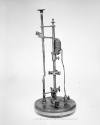
DescriptionA steel bar magnet painted red is vertically mounted. A cylindrical container, which held the battery acid, is fitted circumferentially over the magnet and its connecting wires allow it to pivot and rotate over the magnet. This instrument is unique (compared to published illustrations) in consisting of a single battery, rotating on a single bar magnet.
This is how Davis described in 1842 the batteries, fixed on a horseshoe magnet: "A small double cylinder of copper, closed at the bottom, is supported upon the pole of a magnet, by means of an arch of copper passing across the inner cylinder, and having a pivot projecting downwards from its under surface, which rests in an agate cup on the pole. The inner cylinder of course has no bottom. A cylinder of zinc is supported by a pivot in a similar manner upon the copper arch, and being intermediate in size between the two copper cylinders, hangs freely in the cell. This arrangement allows each plate to revolve independently of the other."
This is how Davis described in 1842 the batteries, fixed on a horseshoe magnet: "A small double cylinder of copper, closed at the bottom, is supported upon the pole of a magnet, by means of an arch of copper passing across the inner cylinder, and having a pivot projecting downwards from its under surface, which rests in an agate cup on the pole. The inner cylinder of course has no bottom. A cylinder of zinc is supported by a pivot in a similar manner upon the copper arch, and being intermediate in size between the two copper cylinders, hangs freely in the cell. This arrangement allows each plate to revolve independently of the other."
Signedunsigned
Curatorial RemarksThe idea that the battery might rotate around a magnet was adapted from André-Marie Ampère's research to a horseshoe magnet by F. Watkins (1832). With the present instrument, the magnet is a steel bar, not a horseshoe. The horseshoe design is illustrated in Davis's <i>Manual of Magnetism</i> (see references). Davis sold the latter one between $5.00 to $8.00 in 1842.
FunctionDemonstration apparatus showing that a small battery will revolve under the influence of a magnet when its circuit is complete.
ProvenanceFrom the Department of Physics, Harvard University.

Department of Physics, Harvard University
Date: mid 19th-late 19th Century
Object number: 0166


U.S. Electrical Supplies
Date: 1910-1920
Object number: 1997-1-0578


