


condensing electroscope
Date1910-1930
Inventory Number0226
ClassificationElectroscope
Subject
Maker
American
?
User
Department of Physics, Harvard University
founded 1884
Cultural Region
Dimensions22.5 × 12 × 8 cm (8 7/8 × 4 3/4 × 3 1/8 in.)
Material
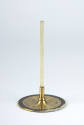
DescriptionIn a cylindrical casing, with glass windows on each side, is found a vertical bar, a metallic (silver?) foil and two moving plates (a capacitor). On top of the casing is a rod and ball, linked to the inside vertical bar. The casing is supported by a post and round base. The latter has been marked with a blue triangle and with the letters "ES" (electrostatics).
Signedunsigned
FunctionThis is a modified gold-leaf electroscope that is more sensitive than standard ones. The improvement comes essentially from adding the two flat discs on the side that form a capacitor. Similar to what is done in the standard gold-leaf electroscope, one would touch the object to be measured with the top ball, which would charge it as well as the rod and the inside metallic foil with an amount of charge proportional to that of the electrified body.
As equal charges repel each other, the metallic foil separates from the central vertical bar, forming a "V" shape. The angle of this "V" gives an indication of how charged is the object that was touched. If the electroscope is small in comparison to the measured object, the amount of electric charge that it takes away from it is small. In addition, if a body has a considerable electric charge, even without physical contact to the metallic ball the metallic foil will separate, as proximity to the ball will push positive charge away from it, towards the metallic foil.
This arrangement can register smaller charges than standard electroscopes. To do so, a charged object is put in contact with the top ball, but this time one of the side capacitor discs touches the central bar and the other one the metallic foil. When they are slowly separated, the electrical capacity diminishes, strengthening the potential in the foil. It is this strengthening of the potential by the capacitor that enables this instrument to detect smaller electric charges.
As equal charges repel each other, the metallic foil separates from the central vertical bar, forming a "V" shape. The angle of this "V" gives an indication of how charged is the object that was touched. If the electroscope is small in comparison to the measured object, the amount of electric charge that it takes away from it is small. In addition, if a body has a considerable electric charge, even without physical contact to the metallic ball the metallic foil will separate, as proximity to the ball will push positive charge away from it, towards the metallic foil.
This arrangement can register smaller charges than standard electroscopes. To do so, a charged object is put in contact with the top ball, but this time one of the side capacitor discs touches the central bar and the other one the metallic foil. When they are slowly separated, the electrical capacity diminishes, strengthening the potential in the foil. It is this strengthening of the potential by the capacitor that enables this instrument to detect smaller electric charges.
ProvenanceFrom the Department of Physics, Jefferson Laboratory, Harvard University.

E. Ducretet & Cie
Date: 1870-1890
Accessories: the upper part of the capacitor is DW0045b.
Object number: DW0045a

CASIO Computer Company, Ltd.
Date: 1970-1980
Accessories: vinyl pouch with folded over snap cover and hanging loop; batteries
Object number: 1995-1-0012

Harold C. Ernst
Date: 1900-1930
Accessories: leveling screw
Object number: 1996-1-0178

Gebrüder Haff
Date: 1960-1969
Accessories: plush-lined, hard green case
white card with instrument information in case
Object number: 1999-1-0005


Frank S. Baldwin
Date: 1897-1907
Accessories: instruction manual (in object file); history of instrument (both in very poor condition)
Object number: 1997-1-0246


Perkin-Elmer Company
Date: ca. 1960-1980
Accessories: power cord
Object number: 2004-1-0007