


core memory module, planar
Datecirca 1954
Inventory Number1997-1-1231
ClassificationCore Memory
Subject
Maker
Honeywell
1885-present
Cultural Region
Place of Origin
Dimensions1.3 × 21.3 × 24.3 cm (1/2 × 8 3/8 × 9 9/16 in.)
box: 5.7 × 27.3 × 21.8 cm (2 1/4 × 10 3/4 × 8 9/16 in.)
box: 5.7 × 27.3 × 21.8 cm (2 1/4 × 10 3/4 × 8 9/16 in.)
Material
Accessorieswhite slip of paper with maker and instrument information
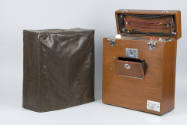
DescriptionThe core memory panel is fixed in a rectangular wooden frame with a hole screwed into each corner. The top pane of the wooden frame is painted brown. The inside bottom edge of the frame is serated. There are fifty copper wires pulled taut between the two long edges of the wooden frame. There are forty, longer copper wires pulled taught between the two short edges of the wooden frame. Each wire goes through one of the grooves on the bottom of the serated lower frame edges and attaches to a metal connection pin fixed to the outside edge of the frame. These two sets of wire form a taught wire grid. Loops of copper wire are interlaced diagonally accross the grid such that three wires meet at each intersection node. At each node, a very small ring composed of magnesium manganese ferrite is wrapped around the three intersecting copper wires.
In Collection(s)
Signedprinted in black lettering on white label with instrument: FERRITE CORE MEMORY PLANE 40 x 50 / Honeywell, ca. 1954
Inscribedhand-written on white instrument card: HONEYWELL / First Computer Memory Card From Steve E(illegible). 11 April 1968
etched in black letters in top right-hand corner of instrument: 135
FunctionThis instrument is used for the storage of data within a computer. Magnesium manganese ferrite (often just called Ferrite) can hold a magnetic field in either of two directions. The metal is thus amenable to binary logic, which is why it is the substance chosen for the core memory rings: 1 and 0 are aligned with the possible magnetic field directions. The copper wires that run through the rings are the means by which a computer "reads" or "sets" the direction of the magnetic field of one of the rings. The core memory communicates with the central processing unit of the computer through connections made with the metal pins around the outside of the wooden frame which are, in turn, attached to the copper wires. Often, panels like this were stacked together to increase the storage capacity of a computer.
Core memory of this type was designed by Jay Forrester while he was working on the Whirlwind Project, to improve the speed and efficiency of computer memory access. Tubes filled with mercury or vacuum tubes were typically used as the memory for older mainframe computers like the ENIAC. While mercury and vacuum tubes could serve the necessary binary function, they were inefficient and took up a lot of space. Whirlwind was a U.S. Navy project aimed mainly at the production of an aircraft simulator for training pilots and bombers.
Click here for a more detailed discussion of the history and the specifications of magnetic core memory.
Core memory of this type was designed by Jay Forrester while he was working on the Whirlwind Project, to improve the speed and efficiency of computer memory access. Tubes filled with mercury or vacuum tubes were typically used as the memory for older mainframe computers like the ENIAC. While mercury and vacuum tubes could serve the necessary binary function, they were inefficient and took up a lot of space. Whirlwind was a U.S. Navy project aimed mainly at the production of an aircraft simulator for training pilots and bombers.
Click here for a more detailed discussion of the history and the specifications of magnetic core memory.
ProvenanceFrom Steve E[illegible]be, 11 April 1968.

American
Date: circa 1970
Accessories: with watchglass
Object number: 1998-1-0577


Walter Balcke
Date: circa 1958
Accessories: in library folder (Lib 4927):
-twenty-one letters from Joseph L. Walsh, mathematics professor at Harvard University, to Walter Balcke, dated between 27 May 1957 and 24 January 1964 (letters thank Balcke for the many mathematical models he gifted to the Mathematics Department, praise his skill and ingenuity, many invite him to faculty and personal luncheons, and one letter provides an analytic solution to the "13-point problem" behind one of Balcke's models)
-three letters from Garret Birkhoff (then Chairman of the Harvard Mathematics Department) dated 3 March 1954, 4 January 1955, and 10 January 1955, each expressing gratitude (and in one case, an official department thank you) for the many mathematical models he gifted to the mathematics department
-photocopy of original envelope in which correspondence between mathematics department and Walter Balcke was stored (original was destroyed on 13 July 1997)
-photocopy of instructional card for object 1997-1-1671
- seven instructional cards that accompany the following Balcke models: Pascal's Theorem, Brianchon's Concurrent Lines, Trisector, Twelve Point Ellipse (pertains directly to this object), Rolling Parabola, unknown, Equation Solution with a 'Constant' Variable and Thread
- photograph of the display case containing Balcke's models in the Harvard Mathematics department
Object number: 1990-5-0031


Sanborn Company
Date: 1930-1945
Accessories: leather cover; cloth cover; thin red wire
Object number: 1996-1-0278

