


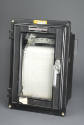
exposed Thomson alternating ammeter
Date1890-1920
Inventory Number1997-1-1071
ClassificationAmmeter
Subject
Maker
General Electric Company
1892-present
User
Department of Physics, Harvard University
founded 1884
Cultural Region
Place of Origin
Place of Use
Dimensions7.7 × 15.6 × 12.3 cm (3 1/16 × 6 1/8 × 4 13/16 in.)
blue board box: 11.4 × 38.1 × 31.1 cm (4 1/2 × 15 × 12 1/4 in.)
blue board box: 11.4 × 38.1 × 31.1 cm (4 1/2 × 15 × 12 1/4 in.)
Material
DescriptionAn ammeter that had its protective cover removed and rests on a square wooden base. A felt outline marks where the cover would meet the base. It has two binding posts near the bottom left and bottom right corners are connected by thin metal rod.
The ammeter consists of a central coil with a pointer made of simple straight wire. Its scale is a roughly semicircular metal plate with an arc-shaped window, suspended above the coil by a metal frame. The instrument's needle moves under the plate so it can be seen through the window. It has no scale markings, except for having "50 amps" handwritten. The blue triangle indicates that this instrument was used for physics instruction at Harvard University.
The ammeter consists of a central coil with a pointer made of simple straight wire. Its scale is a roughly semicircular metal plate with an arc-shaped window, suspended above the coil by a metal frame. The instrument's needle moves under the plate so it can be seen through the window. It has no scale markings, except for having "50 amps" handwritten. The blue triangle indicates that this instrument was used for physics instruction at Harvard University.
Signedon metal plate: THOMSON ALTERNATING AMMETER / NO. (handwritten) 382 / PATENTED JULY 16, 1885 / GEN. ELEC. CO. U.S.A
Inscribedabove the pointer's window, handwritten: 50 amp
below the instrument's signature, handwritten: 50 Amp.
handwritten on coil: 382
on bottom edge of base: 382
Curatorial RemarksFor a complete version of this instrument, see number 2002-1-0001.
FunctionThis ammeter that has been unmounted for inspection and possibly demonstration.
Thomson alternating ammeters were designed to measure alternating current of any frequency. The coil through which the current circulates becomes an electromagnet, attracting a strip of soft iron that moves the pointer.
For a brief description of this instrument see the "Electrical Mesurement Instruments" entry in the 1918 Encyclopedia Americana (New York: Encyclopedia Americana Corp.) Vol 10, p. 318.
Available online at Google Books here.
Thomson alternating ammeters were designed to measure alternating current of any frequency. The coil through which the current circulates becomes an electromagnet, attracting a strip of soft iron that moves the pointer.
For a brief description of this instrument see the "Electrical Mesurement Instruments" entry in the 1918 Encyclopedia Americana (New York: Encyclopedia Americana Corp.) Vol 10, p. 318.
Available online at Google Books here.
ProvenanceFrom the Department of Physics, Harvard University.

Edison Manufacturing Company
Date: circa 1894
Accessories: wooden case (0277a) with removable door (0277b); Edison certification on backside of door; fragment of broken inspection tag inside case reads "The Leeds"...
Object number: 0277a,b,c

Weston Electrical Instrument Corporation
Date: circa 1928
Object number: 1997-1-1065

Weston Electrical Instrument Corporation
Date: 1920-1930
Object number: 1997-1-1057



Weston Electrical Instrument Corporation
Date: circa 1921
Accessories: petri dish (1997-1-1059b) containing three loose binding posts, short lengths of wires, and an array of small mismatched screws, bolts, and washers
Object number: 1997-1-1059a,b


General Electric Company
Date: 1940-1970
Accessories: leather case
Object number: 1997-1-1085


See also/See also
