


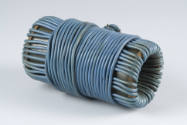
magnetostrictive ring-stack transducer
Date1941-1946
Inventory Number1997-1-0836
ClassificationTransducer
Subject
Maker
Underwater Sound Laboratory, Harvard University
1941 - 1949
Cultural Region
Place of Origin
Dimensions5.4 × 7.5 × 7.5 cm (2 1/8 × 2 15/16 × 2 15/16 in.)
Material
Bibliography
DescriptionThin circular slices of metallic material stacked on top of another that forms a cylinder. An orange-coated wire is wound on have of the transducer.
According to Hunt's report, such transducers "were wound toroidally and were constructed in a wide variety of diameters, radial thicknesses, and stack heights. The rings were punched from sheet stock and consolidated into stacks of the desired height. This construction produced transducers of high efficiency, and a special thin-walled modification had unusually uniform response over a wide frequency range. A technique was developed for casting the ring stacks in plastic resins. The use of vanadium Permendur, even though it is difficult to punch and handle, produced one of the most satisfactory forms of magnetostriction transducer for use at ultrasonic frequencies."
According to Hunt's report, such transducers "were wound toroidally and were constructed in a wide variety of diameters, radial thicknesses, and stack heights. The rings were punched from sheet stock and consolidated into stacks of the desired height. This construction produced transducers of high efficiency, and a special thin-walled modification had unusually uniform response over a wide frequency range. A technique was developed for casting the ring stacks in plastic resins. The use of vanadium Permendur, even though it is difficult to punch and handle, produced one of the most satisfactory forms of magnetostriction transducer for use at ultrasonic frequencies."
Signedunsigned
Curatorial RemarksSeveral types of magnetostrictive transducers were developed at the Underwater Sound Laboratory. For a complete list, until 1946, see Prof. Hunt's report. On pp. 93-94, for instance, are listed the 1. Hydrophones for sound gear monitors; 2. Ring-stack transducers; 3. Laminated-stack transducers; 4. Tube-and-plate transducers; and 5. Miscellaneous transducers.
FunctionA transducer is a device that transform one type of energy (or signal) into another form, so it could be used for another purpose.
ProvenanceFrom Professor Frederick V. Hunt, former director of the Harvard University Underwater Sound Laboratory.

Underwater Sound Laboratory, Harvard University
Date: 1941-1946
Object number: 1997-1-0825

Underwater Sound Laboratory, Harvard University
Date: 1941-1946
Object number: 1997-1-0816
Underwater Sound Laboratory, Harvard University
Date: 1944
Object number: 1997-1-0799

Underwater Sound Laboratory, Harvard University
Date: 1941-1946
Object number: 1997-1-0822

Underwater Sound Laboratory, Harvard University
Date: 1941-1946
Object number: 1997-1-0837

Underwater Sound Laboratory, Harvard University
Date: 1941-1946
Object number: 1997-1-0817

Underwater Sound Laboratory, Harvard University
Date: 1941-1946
Object number: 1997-1-0831

Underwater Sound Laboratory, Harvard University
Date: 1941-1946
Object number: 1997-1-0840

Underwater Sound Laboratory, Harvard University
Date: 1941-1946
Object number: 1997-1-0830

Underwater Sound Laboratory, Harvard University
Date: 1941-1946
Object number: 1997-1-0833

Underwater Sound Laboratory, Harvard University
Date: 1941-1946
Object number: 1997-1-0819

Underwater Sound Laboratory, Harvard University
Date: 1941-1946
Object number: 1997-1-0818