


Einthoven string galvanometer for electrocardiograph
Date1914-1921
Inventory Number1997-1-0312
ClassificationString Galvanometer
Subject
Maker
Hindle Instrument Company
1914 - 1922
Cultural Region
Place of Origin
Dimensions39 x 58 x 42 cm (15 3/8 x 22 13/16 x 16 9/16 in.)
Material
DescriptionInvented by the Dutch Wilhelm Einthoven, the electrocardiogram was based on a galvanometer of his own invention, which became known as a string galvanometer. What this instrument did was to measure and record the electrical current produced by the human heart.
A patient was half immersed in a salt water solution and connected to the instrument via a filament, which is found in the central vertical cylinder. Two sliding windows allowed the instrument user to fix the string. A knob at the top was added to adjust the tension in the string. This string was positioned between the poles of a powerful electromagnet, the magnetic field produced here by the series of coils disposed in a toroidal shape.
The electric current produced by the heart (measured in millivolt) was transmitted to the filament, which began to vibrate slightly because it was put in a magnetic field. The movement was projected and magnified by a microscope (the horizontal extensions seen here on the right and left of the instrument). Before the eyepiece an incandescent lamp provided the light (missing here) and the projection was recorded at the other end by a photographic paper attached to a rotating drum (missing here).
This string galvanometer was known as Hindle No. 2.
A patient was half immersed in a salt water solution and connected to the instrument via a filament, which is found in the central vertical cylinder. Two sliding windows allowed the instrument user to fix the string. A knob at the top was added to adjust the tension in the string. This string was positioned between the poles of a powerful electromagnet, the magnetic field produced here by the series of coils disposed in a toroidal shape.
The electric current produced by the heart (measured in millivolt) was transmitted to the filament, which began to vibrate slightly because it was put in a magnetic field. The movement was projected and magnified by a microscope (the horizontal extensions seen here on the right and left of the instrument). Before the eyepiece an incandescent lamp provided the light (missing here) and the projection was recorded at the other end by a photographic paper attached to a rotating drum (missing here).
This string galvanometer was known as Hindle No. 2.
Signedon plate, in front: TRADE / HINDLE / MARK
on microscope eyepiece: SPENCER LENS CO.
Inscribedon knob: TO SLACKEN STRING [with arrow pointing in to the right]
FunctionThis instrument was most likely used as a string galvanometer per se, for physics experiments, not as an electrocardiograph. The basic principle of this instrument is opposite of a common galvanometer. Instead of having a current pass through a stationary coil, creating a magnetic field which will then act on a movable magnet, this instrument is made of a stationary magnet between which an electric current to be determined passes through a fine wire. For more information on this type of instrument, go to the following website.
String galvanometers were essential to early electrocardiograph. For an image of such a set-up, go to the following website.
String galvanometers were essential to early electrocardiograph. For an image of such a set-up, go to the following website.

Hindle Instrument Company
Date: circa 1920
Accessories: entire electrocardiograph consists of: bench (RS0372), string galvanometer(RS0372a), time marker (RS0372b), photographic recorder (RS0372f), and several accessories and parts (RS0372c,d,e,g)
Object number: RS0372a

Cambridge Instrument Company, Ltd.
Date: 1924-1935
Object number: 1989-0031a,b
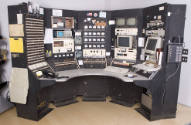
Harvard Cyclotron Laboratory
Date: 1947-2002
Object number: 2003-1-0291


Sanborn Company
Date: circa 1940
Accessories: 1 battery (removed during FAE inventory); photographic recorder (RS0361a); cable (RS0361b); rotary time marker (RS0361e); electromagnet (RS0361f); unidentified accessories (RS0361b,c,d)
Object number: RS0361


Adam Hilger Ltd.
Date: circa 1930
Object number: 1996-1-0675

See also/See also
