


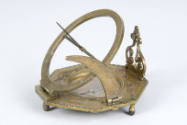
Augsburg-type sundial
Date1791
Inventory Number7061
ClassificationSundial
Subject
Maker
Pr. Hoppers
Cultural Region
Place of Origin
Dimensions1.5 × 6.3 × 6.3 × 6.3 cm (9/16 × 2 1/2 × 2 1/2 × 2 1/2 in.)
Material
DescriptionThis circular, brass sundial has a removable lid that is engraved with concentric circles. The dial plate has an adjustable, decoratively shaped plumb-bob opposite the hinge of the equatorial ring. The bob is missing.
The compass has a large sixteen-point wind rose engraved in the center and further divided by small lines into 32 sections. The abbreviations for the four cardinal points are engraved in their corresponding places. There is a small line for magnetic declination at approximately 10° west. The compass needle itself is tapered on either side.
The equatorial ring is circular and engraved on the top surface with an hour scale. The hour scale is marked with Roman numerals IIII-XII-VII. The inner surface of the dial is also engraved with an hour scale marked 7-12-5. Engraved on the underside of the ring is the maker’s signature, city and date. The sundial's gnomon is a pin mounted to the center of a turned, rotating bar that bridges the 6 o'clock hours.
The latitude arm is marked from 1° to 89° every 10°, and is further divided by 1° increments
The underside of the dial is also engraved with concentric circles. This dial has handwritten instructions, in Dutch, folded loosely inside the case.
The compass has a large sixteen-point wind rose engraved in the center and further divided by small lines into 32 sections. The abbreviations for the four cardinal points are engraved in their corresponding places. There is a small line for magnetic declination at approximately 10° west. The compass needle itself is tapered on either side.
The equatorial ring is circular and engraved on the top surface with an hour scale. The hour scale is marked with Roman numerals IIII-XII-VII. The inner surface of the dial is also engraved with an hour scale marked 7-12-5. Engraved on the underside of the ring is the maker’s signature, city and date. The sundial's gnomon is a pin mounted to the center of a turned, rotating bar that bridges the 6 o'clock hours.
The latitude arm is marked from 1° to 89° every 10°, and is further divided by 1° increments
The underside of the dial is also engraved with concentric circles. This dial has handwritten instructions, in Dutch, folded loosely inside the case.
Signedon underside of equatorial ring: Pr: Hoppers. Facit. Rotterdam. 1791
Curatorial RemarksAppraisal by Brieux, 9/24/84: $500
ProvenanceJoseph Drecker, Aachen, Germany, before 1928 (no. 191); Frederik Casparus Wieder, Noordwijk, The Netherlands, 1928; D. P. Wheatland, Topsfield, MA, 1959; gift to CHSI, ca. 1987.


Joseph Daniel Mayr
Date: 1735-1770
Accessories: case
Object number: HO81Z-12


Johann Nepomuk Schrettegger
Date: circa 1800
Accessories: case
Object number: 7093

Johann Nepomuk Schrettegger
Date: late 18th Century
Accessories: case
Object number: 7476


Johann Nepomuk Schrettegger
Date: circa 1800
Accessories: case
Object number: 7086

Johann Nepomuk Schrettegger
Date: circa 1800
Accessories: case
Object number: 7087