


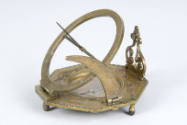
Augsburg-type sundial with case
Datecirca 1750
Inventory Number7062
ClassificationSundial
Subject
Maker
Johann Georg Vogler
1720 - 1765
Cultural Region
Place of Origin
Dimensionsclosed: 1.5 x 6.5 x 6.7 cm (9/16 x 2 9/16 x 2 5/8 in.)
Material
Accessoriescase
DescriptionThis Augsburg-type sundial is made of gilt and silvered brass, although much of the silvering is worn away. The base of the sundial in ornamented with scrollwork and shell decorations. The plumb-bob bracket is pierced and trimmed with scrollwork. The large central compass has a silvered wind rose with four points labeled in abbreviated Latin. An arrow marks magnetic declination at approximately 17°W. The latitude arm is silvered and divided 4°-90° by 2° intervals. The silvered hour scale is marked III-XII-IX by 1/2 hour intervals on the top and 4-12-8 by 1/2 hours on the inner edge. The gnomon is of the T-bar form.
On the underside of the base there are three small feet. The spring for the plumb-bob bracket has shell and scrollwork ornamentation, and may once have been silvered. The underside of the compass bowl is also silvered and has a running leaf decoration. There are 18 cities included in the engraved gazetteer, which ranges from Europe to India. The gazetteer is titled, "Elev Poli."
The instrument has matchmarks (or assembly marks) on these components: the base (III), the hinge of the hour ring (III), the edge of the latitude scale (III and I), the plumb-bob bracket (III), the hour ring (III), and the compass well (III).
The octagonal case is made of cardboard, paper, and leather. It has a robin's egg blue interior. The exterior is simple brown leather. The hinge is torn. There is one brass hook and eye.
On the underside of the base there are three small feet. The spring for the plumb-bob bracket has shell and scrollwork ornamentation, and may once have been silvered. The underside of the compass bowl is also silvered and has a running leaf decoration. There are 18 cities included in the engraved gazetteer, which ranges from Europe to India. The gazetteer is titled, "Elev Poli."
The instrument has matchmarks (or assembly marks) on these components: the base (III), the hinge of the hour ring (III), the edge of the latitude scale (III and I), the plumb-bob bracket (III), the hour ring (III), and the compass well (III).
The octagonal case is made of cardboard, paper, and leather. It has a robin's egg blue interior. The exterior is simple brown leather. The hinge is torn. There is one brass hook and eye.
In Collection(s)
Signedon underside of compass bowl: I G V
FunctionThe Augsburg-type sundial was a popular form of portable, universal equatorial sundial made in Augsburg. The dial is octagonal in shape.
ProvenanceJoseph Drecker, Aachen, Germany, before 1928 (no. 72); Frederik Casparus Wieder, Noordwijk, The Netherlands, 1928; D. P. Wheatland, Topsfield, MA, 1959; gift to CHSI, ca. 1987.


Ludovicus Theodatus Müller
Date: 1750-1770
Accessories: case
Object number: 7079


Ludovicus Theodatus Müller
Date: circa 1760
Accessories: case
Object number: 7077


Johann Nepomuk Schrettegger
Date: late 18th Century
Accessories: case
Object number: 7476

Ludovicus Theodatus Müller
Date: circa 1760
Accessories: case
Object number: 7076