


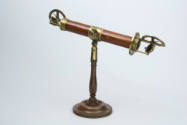
polarizing microscope
Date1850-1900
Inventory Number1105
ClassificationPolarimeter
Subject
Maker
French
?
Cultural Region
Dimensions31 × 12.3 × 17 cm (12 3/16 × 4 13/16 × 6 11/16 in.)
Material
DescriptionThis instrument looks like a microscope. The base is circular and supports a mirror (broken) and a stack of glass plates, acting as a polarizer. The mirror pivots whereas the glass plates are fixed. Both slide horizontally and are held in place by a thumb screw. In the middle is a stage with a condenser. The stage would also hold the transparent sample to be analyzed. Above that, an optical tube and an eyepiece, in which is found a Nicol prism (the analyzer). There is a gap between the tube and eyepiece, allowing for a circular scale divided every five degrees and marked every 30 (0-180°-0). The latter rotates and the angle of rotation is read from an engraved pointer. The tube is moved up and down by a rack and pinion mechanism to provide coarse adjustment.
Signedunsigned
Curatorial RemarksFrench physicist Etienne Louis Malus (1775-1812) discovered the polarization of light by reflection in 1808 and double refraction (bi-refringence) in crystals in 1810. The explanation of the first phenomena is a convincing demonstration of the transverse nature of light waves and leads to Malus' law, which describes the intensity of polarized light in terms of the square of the cosine of the angle of polarization. The polarizing microscope was devised by Giovan Battista Amici (1786-1863) around 1830. German chemist Johann Gottlieb Christian Nörrenberg (1787-1862) was the first to use a Nicol prism as an analyser with this form of apparatus (c. 1830-1840).
FunctionThis instrument would have been used to measure the optical rotation of light caused by a transparent substance.
Sunlight (most likely) would be reflected from the plain mirror onto the stack of glass plates (polarizer), which would polarize the light and refract it upwards. This polarized light would encounter a condenser (to focus the light), held in place by a stage, on which would be put the transparent sample to be analyzed. Light would go through the sample and up towards the tube and eyepiece, which has the analyzer (a Nicol prism). A circular scale put in the gap between the tube and eyepiece is used to measure the angle of polarization.
For other types of polarimeters, see the following website.
Sunlight (most likely) would be reflected from the plain mirror onto the stack of glass plates (polarizer), which would polarize the light and refract it upwards. This polarized light would encounter a condenser (to focus the light), held in place by a stage, on which would be put the transparent sample to be analyzed. Light would go through the sample and up towards the tube and eyepiece, which has the analyzer (a Nicol prism). A circular scale put in the gap between the tube and eyepiece is used to measure the angle of polarization.
For other types of polarimeters, see the following website.
ProvenanceFrom the Allston Burr cabinets, Harvard University; Jefferson Physics Laboratory, Harvard University.




Jean Baptiste François Soleil
Date: 1840-1860
Accessories: carrying case; objective; double refraction ocular; substage polarizer; rotating stage plate; horizontal case; stage forceps; oculars (2)
Object number: 1215

Ernst Leitz (company)
Date: circa 1919
Accessories: oculars (2): 3, 8x; accessory box; Leitz objectives (5); wrenches (2); ground glass; N.A. 1.45 condensor cap; Abbe condensor; rotary stage; case
Object number: 1345
