


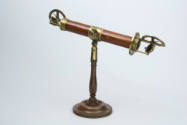

polarimeter
Date1810-1830
Inventory Number0088
ClassificationPolarimeter
Subject
Maker
W. & S. Jones
fl. 1791 - 1859
Cultural Region
Place of Origin
Dimensions36 × 43 × 14 cm (14 3/16 × 16 15/16 × 5 1/2 in.)
Material
Bibliography
DescriptionThis instrument consists of a mahogany tube that can pivot horizontally and vertically. At each end is found a circular black mirror mounted on two supporting rods. One of these is actually a semi-circular brass scale marked in single degrees, numbered by tens, and reading from 90°-0-90°. When the mirror pivots, a pointer on the semi-circular scale indicates the angle of rotation. At one end there is also a full circular scale in brass, marked in single degrees, numbered by tens and reading from 90°-0-90°-0-90°. This scale indicates the horizontal angle of rotation of the black mirror to which it is fixed. The polarimeter is supported by a turned round base and pillar, the former weighted to give the apparatus more stability.
This device has black mirrors as both the polarizer and analyzer, as is consistent with the earliest polarimeters designed in the 1810's (quartz and Nicol prisms became more widely used after 1830).
It is marked with an old Harvard number: 9 174.
This device has black mirrors as both the polarizer and analyzer, as is consistent with the earliest polarimeters designed in the 1810's (quartz and Nicol prisms became more widely used after 1830).
It is marked with an old Harvard number: 9 174.
Signedon circular scale, script: W & S Jones Holborn
FunctionThe first black mirror could be positioned to polarize light (from the sun or any other source) by reflection. The polarized light would go through the tube and end up on the second black mirror. The intensity of the transmitted light beam would vary as the second (analyzer) black mirror was pivoted on its axis. At right angles the light beam would be extinguished. This instrument would not have been used to measure the optical rotation of transparent substances, as others were designed to do so.
For other similar type of instruments, see the following website.
For other similar type of instruments, see the following website.
ProvenanceJefferson Physical Laboratory, Harvard University; transferred to CHSI May 1948.

Fr. J. Berg
Date: circa 1900
Accessories: not complete (missing several acessories) has spare needle, leather strap
Object number: 5132

Edward Nairne
Date: 1765
Accessories: Small magnifying glass on end of box to assist in aligning the dip needle.
Object number: 0026

E. S. Ritchie & Sons
Date: 1919
Accessories: case
Object number: 5330b


Chamberlain & Ritchie
Date: 1850-1854
Accessories: carrying case; tripod (5129b)
Object number: 5129a

Buff & Buff Manufacturing Company
Date: circa 1905
Accessories: wood case; leather case; right-angle prism; plumb bob; oil flask; tripod (5174b)
Object number: 5174a

Sterling P. Fergusson
Date: 1931
Object number: 1998-1-1051b

Charles Bloud
Date: 1653
Accessories: Stored in briefcase (not with sundial in its present location).
Object number: 7800


Jakob Amsler
Date: circa 1906
Accessories: instrument is in four (4) parts; the rail is in own box and is inventory # 2006-1-0002b; letter from Prof. William Brower containing the complete history of ownership and use (missing)
Object number: 2006-1-0002a

Union Instrument Corporation
Date: circa 1940
Accessories: wooden case
Object number: 2004-1-0374