


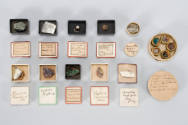
high-pressure samples in six boxes
Date1928-1957
Inventory Number1999-1-0045b
ClassificationHigh-Pressure Samples
Subject
Maker
Percy Williams Bridgman
1882 - 1961
Maker
Billings & Stover, Apothecaries
1854 - 2002
Cultural Region
Place of Origin
Place of Use
Dimensions7.8 x 13.3 x 8.4 cm (3 1/16 x 5 1/4 x 3 5/16 in.)
Material
Accessoriestwo small rectangular cardboard boxes
three small round cardboard boxes
one large round cardboard box
DescriptionSix cardboard boxes containing various wire and metal samples. Four of the boxes are white and round with black strips around the circumference. Two of the boxes are small and rectangular with white faces and pink strips around the sides.
The large round box contains a granite cylinder, hollowed out down the center. The granite is grey and heterogeneous. The box also contains a smaller granite cylinder in a metal casing with copper ends and a piece peeled back off the side. Two flat copper discs (possibly alternate copper ends to the casing) are also loose in the box.
Both of the small rectangular boxes contain a doughnut of tightly wound wire with connectors and two rectangular cubes of a somewhat shiny metal.
One of the small round boxes contains a thin flat disc of platinum with a red substance around parts of the circumference and loose flakes of the red material, probably broken off.
Another of the small round boxes contains a thin flat disc of lanathum with a red substance around parts of the circumference and loose flakes of the red material, probably broken off.
The third small round box contains a chunk of carbon that appears black, somewhat shiny and has a small piece broken off.
The large round box contains a granite cylinder, hollowed out down the center. The granite is grey and heterogeneous. The box also contains a smaller granite cylinder in a metal casing with copper ends and a piece peeled back off the side. Two flat copper discs (possibly alternate copper ends to the casing) are also loose in the box.
Both of the small rectangular boxes contain a doughnut of tightly wound wire with connectors and two rectangular cubes of a somewhat shiny metal.
One of the small round boxes contains a thin flat disc of platinum with a red substance around parts of the circumference and loose flakes of the red material, probably broken off.
Another of the small round boxes contains a thin flat disc of lanathum with a red substance around parts of the circumference and loose flakes of the red material, probably broken off.
The third small round box contains a chunk of carbon that appears black, somewhat shiny and has a small piece broken off.
Signedprinted in black on lid of small rectangular box: BILLINGS & STOVER. / APOTHECARIES. / 1360 Massachusetts Ave. Harvard Square. / CAMBRIDGE, MASS. / No. / MA28
printed in black on lid of small rectangular box: BILLINGS & STOVER. / APOTHECARIES. / 1360 Massachusetts Ave. Harvard Square. / CAMBRIDGE, MASS. / No. / MA27
Inscribedhandwritten on the original storage box: P.W. Bridgeman / Compressed & Samples etc.
handwritten on a tag attached to small square box: MA27 / Out of Anneal / Nov. 3 9 A.M.
handwritten on a tag attached to small square box: MA28 / Out of Anneal / Oct. 30 1928
handwritten in pencil on top of large round box: IE / .230 [lightly crossed out] x .562 / .229 / Quincy
Granite
handwritten in black on top of small round box: Platinum / Dummy Run / 779 Blicks / CP 118 / Mar. 5 1951
handwritten in black on top of small round box: Lanathum / CP 34 / 779 Blicks / March 28, 1951
handwritten in pencil on top of small round box: Used for / diamond / attempts / Mar 1951 / CP -
Curatorial RemarksThe boxes are no longer stored in their original cardboard box. One of the boxes is labeled 1957, two are labeled 1951, and one is labeled 1928. The relationship between the samples is not known.
FunctionHigh-pressure physics.
These samples were used in or produced by experiments on the properties of substances in high pressure apparatuses. The sample of carbon was used in Percy Bridgman's attempts to artificially synthesize diamonds from other materials using high pressures and temperatures.
Oxford English Dictionary, 2nd. Ed.: " Lanthanum: A rare element belonging to the group of earth metals, found in certain rare minerals, e.g. cerite; it was discovered by Mosander 1839-41. Symbol Ln."
These samples were used in or produced by experiments on the properties of substances in high pressure apparatuses. The sample of carbon was used in Percy Bridgman's attempts to artificially synthesize diamonds from other materials using high pressures and temperatures.
Oxford English Dictionary, 2nd. Ed.: " Lanthanum: A rare element belonging to the group of earth metals, found in certain rare minerals, e.g. cerite; it was discovered by Mosander 1839-41. Symbol Ln."
ProvenanceFrom Prof. Percy Bridgman, Dept. of Physics, Harvard University.
Historical AttributesPercy Bridgman's experimental work at Harvard University consisted mainly in the production of very high pressures and the investigation of the effects such pressures have on the properties of matter.
During the 1920s, most of Bridgman's experiments used high pressures between 12 000 and 20 000 atmospheres (12,000-20,000 kg/cm²). In order to produce such high pressures, Bridgman used a hydraulic press in conjunction with two pumps in order to produce the high pressures. See for example, 1997-1-1819a, b, c and d.
During the 1930s, Bridgman increased the pressure, reaching between 30 000 and 50 000 atmospheres using two and even three hand pumps.
Bridgman would put samples of various materials into a chamber of the press, raise the pressure inside the chamber, and then study the material samples or residues that remained afterward. He the effects of high pressures on the <i>specific resistance, temperature coefficients, volume, electrical conductivity, shearing strength, electrical resistance, density, tensile properties,</i> and <i>compression</i>. He studied these effects on all manner of substances from minerals, metals, and chemicals to plastics, glass and egg yolks. Bridgman hoped his experimental results would contribute to theories of the internal structure of atoms and molecules that were gaining attention throughout the first half of the 20th century. He was awarded the Nobel Prize for Physics in 1946 for his research.
Bridgman also did work on the synthesis of diamonds from graphite using very high pressures and temperatures. Early in 1941, the General Electric Company arranged a five year agreement with Bridgman to finance his experimental research in producing diamonds. Bridgman wanted to reverse a known process in which diamonds turn to graphite at atmospheric pressure and 1500°C. His experiments were conducted in the Harvard Geophysical Laboratory. However, Bridgman was ultimately unsuccessful in the synthesis of diamonds, and his continued research was interrupted by the outbreak of the Second World War.

Claude-Siméon Passemant
Date: 1749-1769
Accessories: ocular; objectives (7); bull's eye condenser; Lieberkühn for stage mounting; cone diaphragm; spring frame for slides; frog plate; stage forceps; large and small black and white disks (2); round micrometer slide with fine wire screen; low-power lens; black aperture disk; brass slider for 4 specimens; ivory slides--rectangular (6); ivory slides--circular (2); brass slide with aperture to hold circular ivory slides; boxes (2) of round ivory slides (40 in total).
Object number: 1182

Sylvania
Date: late 19th-early 20th Century
Object number: RS0368

Edward Marmaduke Clarke
Date: 1838-1840
Accessories: 5 objectives for simple microscope; 2 objectives for compound microscope (1 in can; 1 with lieberkuhn); cup diaphragm with lieberkuhn in brass box; brass box of cover slips; stage forceps; tweezers; 2 live boxes; frog plate; bull's eye; fish tube wire; wrench; chamois; 2 unmounted lenses; 40 prepared slides; standing case; 2 keys.
Object number: 1018

George Gilbert Rakestraw
Date: 1878-1905
Accessories: microscope in its box (2004-1-0339b) ; bullseye condensers (2003-1-0339c,d); mineralogy books (in the CHSI library)
Object number: 2004-1-0339a


C. P. Goerz
Date: 1906-1916
Accessories: slide holders (10); leather purses for slide holders (2); leather purse-like case for camera; boxes of Cramer's Photo Dry Plates (3); boxes of Wratten & Wainwright photo plates (2)
Object number: 2008-1-0313

Georges Oberhaeuser
Date: 1848
Accessories: objectives (2): 4 and 7; oculars (2): 2 and 3; bull's eye lens; 2 boxes of cover glasses; numbered mahogany flat case with key.
Object number: 1165

Richard W. Thomas
Date: circa 1861
Accessories: bottle and beaker (1998-1-1634a); hydrometer and manual (1998-1-1634b)
Object number: 1998-1-1634

Baumann
Date: 1775-1800
Accessories: 6 objectives: 1-6; 1 eyepiece; 1 partial objective; a lieberkuhn in a brass box; 2 wooden sliders; 1 ivory slider; ivory box with cover slips and springs; 2 spring stages (slider holders); cup diaphragm; wheel diaphragm; frog plate; 2 live boxes; tweezers; steel tweezers with pin; magnifying glass; 2 ivory rings; horizontal box.
Object number: 1253

Troughton & Simms
Date: circa 1840
Accessories: mahogany box with brass handle; sun shade for telescope
Object number: 5234
George Gilbert Rakestraw
Date: circa 1890
Accessories: none
Object number: 2004-1-0325b

Johannes J. Jungerhans
Date: after 1926
Accessories: one of the boxes contains several notes and other writings in Dutch
Object number: 2002-1-0075c
See also/See also
