


ionization chamber
Date1980-1984
Inventory Number2003-1-0294
ClassificationIonization Chamber
Subject
Maker
Harvard Cyclotron Laboratory
1937 - 2002
Maker
U.S. Gauge Company
founded 1904
Cultural Region
Place of Origin
Dimensions19.5 x 18 x 5 cm (7 11/16 x 7 1/16 x 1 15/16 in.)
chamber diam.: 15.3 cm (6 in.)
chamber diam.: 15.3 cm (6 in.)
Material
DescriptionThere is a good chance this instrument was shop-built at Harvard. Only the pressure gauge and brass connector to the chamber would have been bought from a manufacturer.
This chamber, circular in shape, is made of two thick pieces of aluminum joined together by a series of eight screws encased in connecting tubes. The center on both sides has been cut-out, and has been covered by a thin piece of aluminum serving as a window. This is where the gas would have been held inside the chamber. There are two gas connectors. To one is attached a pressure gauge that gives the pressure inside the chamber (0-15 psi). There are two coaxial electrical connectors, one for the signal (SIG) and another for high voltage (H.V.)
The proton beam would go through the foils in the chamber that collect the current.
This chamber, circular in shape, is made of two thick pieces of aluminum joined together by a series of eight screws encased in connecting tubes. The center on both sides has been cut-out, and has been covered by a thin piece of aluminum serving as a window. This is where the gas would have been held inside the chamber. There are two gas connectors. To one is attached a pressure gauge that gives the pressure inside the chamber (0-15 psi). There are two coaxial electrical connectors, one for the signal (SIG) and another for high voltage (H.V.)
The proton beam would go through the foils in the chamber that collect the current.
In Collection(s)
Signedon gauge: USG / U.S. Gauge / 13398-1
on connecting valve: Imperial
Inscribednear coaxial connector, hand-written: SIG
FunctionAn ionization chamber is used in two different ways: to detect particles in air (as in a smoke detector) and to detect or measure ionizing radiation.
In our case, it was used for the latter purpose. The coaxial cylinders are conducting electrodes, immersed in a gas held within the chamber to a certain pressure. When high-energy particles (alpha, beta, X-rays, and protons in this case) pass through the chamber, they ionize the gas and produce ions, which are then attracted by one of the electrodes. This movement of particules creates an ionization current that can be measured by a galvanometer or an electrometer.
In our case, it was used for the latter purpose. The coaxial cylinders are conducting electrodes, immersed in a gas held within the chamber to a certain pressure. When high-energy particles (alpha, beta, X-rays, and protons in this case) pass through the chamber, they ionize the gas and produce ions, which are then attracted by one of the electrodes. This movement of particules creates an ionization current that can be measured by a galvanometer or an electrometer.
Historical AttributesThis was used at the Harvard Cyclotron Laboratory to measure the strength of the proton beam in terms of protons/second.

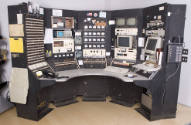
Harvard Cyclotron Laboratory
Date: 1947-2002
Object number: 2003-1-0291
Varian Associates
Date: circa 1964
Accessories: metal maker's name plate is on top of the other maser's cavity on B18-E5.
Object number: 1998-1-1628

Hewlett-Packard Company
Date: circa 1965
Accessories: cavity resonator (1990-7-0004b), name plate (1990-7-0004c)
Object number: 1990-7-0004a.1

Hewlett-Packard Company
Date: circa 1965
Accessories: cavity resonator (1990-7-0004b)
Object number: 1990-7-004a.1
Hewlett-Packard Company
Date: circa 1965
Accessories: cavity resonator (1990-7-0004b), name plate (1990-7-0004c)
Object number: 1990-7-0004a.2

Scientific Prototype Manufacturing Corporation
Date: 1960
Accessories: manual: <i>Laboratory Studies in the Analysis of Behavior</i> by Homme and Klaus (1957)
Object number: 2008-1-0003


Hellige, Inc.
Date: 1949-1960
Accessories: wooden box
flexible black rubber tube with rigid white plastic connector at one end and a bulb-shaped glass chamber at the other end
metal pin with hardened red-rubber cap
Object number: 2003-1-0093

National Institute of Mental Health
Date: circa 1998
Accessories: computer (2004-1-0403b); computer screen with mask (2004-1-0403c); plus a control box; spare Plexiglas touchscreen mask; food pellet distributor
Object number: 2004-1-0403a

