


Pulsatile blood pump, model 1401
Date1965-1985
Inventory Number2009-1-0044
ClassificationBlood Pump
Subject
Maker
Harvard Apparatus Company
1901-present
User
Harvard Medical School
founded 1782
User
Division of Engineering and Applied Sciences, Harvard University
?
1946 - 2007
Cultural Region
Place of Origin
Place of Use
Dimensions33.2 × 21.1 × 53 cm (13 1/16 × 8 5/16 × 20 7/8 in.)
Material
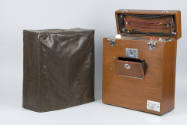
DescriptionThis instrument is brown, encased in metal, and trapezoidal in shape.
A pumping head protrudes from the front of the instrument. It consists of a cylinder which is attached to an internal piston, a transparent chamber, and two valves, one of which has an output nozzle (discharge) and the other of which has an input nozzle (suction). Attached to the input and output nozzles are red tubes held in place with metal rings.
On the right side of the instrument, there is a black knob which adjusts CC PER STROKE.
On the top of the device, there is a silver metal carrying handle, a large black knob, and a metal plate with an RPM dial. The RPM dial includes instructions for the mean rate of pulsation as well as the phase ratio.
On the back of the instrument, there is a silver plate with two silver knobs that control STROKES PER MINUTE: knob A for DIASTOLE strokes and knob B for SYSTOLE strokes. Below the knobs there are two black fuse knobs, a red indicator light, and a power switch. Underneath the plate is an input for the power cord.
A pumping head protrudes from the front of the instrument. It consists of a cylinder which is attached to an internal piston, a transparent chamber, and two valves, one of which has an output nozzle (discharge) and the other of which has an input nozzle (suction). Attached to the input and output nozzles are red tubes held in place with metal rings.
On the right side of the instrument, there is a black knob which adjusts CC PER STROKE.
On the top of the device, there is a silver metal carrying handle, a large black knob, and a metal plate with an RPM dial. The RPM dial includes instructions for the mean rate of pulsation as well as the phase ratio.
On the back of the instrument, there is a silver plate with two silver knobs that control STROKES PER MINUTE: knob A for DIASTOLE strokes and knob B for SYSTOLE strokes. Below the knobs there are two black fuse knobs, a red indicator light, and a power switch. Underneath the plate is an input for the power cord.
Signedon front: PULSATILE/BLOOD / PUMP / MODEL 1401 / SER. NO. 120 / HARVARD APPARATUS CO. / DOVER, MASS. / THIS PUMP IS NOT EXPLOSION PROOF / FOR EXPERIMENTAL USE ONLY ON LABORATORY ANIMALS;
on back: PULSATILE BLOOD PUMP / MODEL 1401 / 115 V. 50-60~ / HARVARD APPARATUS CO. / DOVER, MASS.;
on top: HARVARD APPARATUS CO., INC. / DOVER, MASS., U.S.A.
Inscribedon top: the A and B from the RPM panel seem to have been added later;
red label on the back: APP. PHYSICS
Curatorial RemarksAPP PHYSICS may refer to what became the Division of Engineering and Applied Sciences, Harvard.
FunctionThis instrument was used for experiments on animals. Given the size and pumping capabilities of this instrument, it was most likely used for experimental work on dogs and monkeys. It simulates the ventricular action of the heart and was designed to pump blood in a streamlined flow to avoid damaging blood cells.
A instrument manual for a similar pulsatile blood pump can be found here.
A instrument manual for a similar pulsatile blood pump can be found here.
ProvenanceThis instrument was a gift from Reiner Beeuwkes, Professor emeritus, Harvard Medical School, Department of Physiology. Twenty years ago Prof. Beeuwkes rescued this instrument from Prof. McMahon's Laboratory, Harvard Medical School, Department of Physiology.

Librairie Hachette & Cie
Date: late 19th Century
Object number: 1998-1-1109


Flow Corporation
Date: circa 1965
Accessories: operating instructions; screwdriver; recharging cord; sensor
Object number: 1999-1-0060

Allen B. Du Mont Laboratories, Inc
Date: 1940-1960
Object number: 1999-1-0003
Sanborn Company
Date: 1930-1945
Accessories: leather cover; cloth cover; thin red wire
Object number: 1996-1-0278

Carl Zeiss Jena
Date: circa 1926
Accessories: wooden box with two hook-and-eye latches to fasten front opening; in instrument file: instruction book (photocopy); Geissler tube labeled "H2"; carboard tube containing German thermometer C in stainless steel holder that screws into instrument; glass bottle with cork stopper labeled "Monobromnaphthalin, Germany nD=1 658"; small round cardboard box labeled "For Pulfrich Refractometer" containing one tubulure
Object number: 1996-1-0229

General Electric Company
Date: circa 1945
Object number: 1997-1-0514

George Washington Pierce
Date: circa 1926
Accessories: 8 batteries (removed during FAE inventory).
Object number: RS1275

National Electric Instrument Company, Inc.
Date: 1920-1940
Accessories: in drawer: cautery pistol with cord and plug (1), cauterizing points (8) (two cauterizing points in plastic tubes, six without plastic tubes, and two empty plastic tubes)
Object number: 2009-1-0049

Radio Corporation of America
Date: 1922-1923
Object number: RS0038