


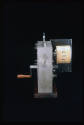

memory drum
Datecirca 1900
Inventory NumberWJ0115
ClassificationMemory Drum
Subject
Maker
Max Marx
Cultural Region
Place of Origin
Dimensions24 x 14.9 x 10.5 cm (9 7/16 x 5 7/8 x 4 1/8 in.)
large rotation cylinder: 8.2 cm (3 1/4 in.)
case: 28 x 24 x 19 cm (11 x 9 7/16 x 7 1/2 in.)
large rotation cylinder: 8.2 cm (3 1/4 in.)
case: 28 x 24 x 19 cm (11 x 9 7/16 x 7 1/2 in.)
Material
Accessoriesextra gear and rotation drum; crank; screen; roll of paper; carrying case
DescriptionA rectangular metallic device on a wooden base. The device consists of a sealed box that contains a rotation mechanism, an attached rotating drum, and a removable screen that limits the view of the drum to a narrow horizontal strip. The drum has a piece of paper with three-digit numbers printed on it at regular intervals. On the backside of the instrument is a metallic dial, and on the opposite side to the drum is a crank.
The device has several spare pieces (see accessories) and is stored in a wooden box.
The device has several spare pieces (see accessories) and is stored in a wooden box.
Signedon plaque: MAX MARX / Mechanische Werkstätten BERLIN N. W. 7 / Georgenstr. 34/36
FunctionThis is a device for studying association and memory. The principle is to show the experimental subject a series of words, syllables or other stimuli (colors, drawings) for short definite intervals of time and instruct the person to do a certain task which could go from simply remembering as much as possible, to constructing words and phrases and other sophisticated tests to investigate how the mind processed this input.
This is a relatively recent model (the first ones date from the 1880s-1890s) where all mechanical components are inside a metallic box. It would be wound up by the crank and activated with the screen facing the subject. Several gears and possibly the dial would let the experimenter choose the appropriate speed for the drum.
This is a relatively recent model (the first ones date from the 1880s-1890s) where all mechanical components are inside a metallic box. It would be wound up by the crank and activated with the screen facing the subject. Several gears and possibly the dial would let the experimenter choose the appropriate speed for the drum.
ProvenanceFrom the Department of Psychology, Harvard University.


Harvard Computation Laboratory
Date: 1949-1950
Object number: 2007-1-0063

Ralph Gerbrands Company
Date: circa 1960
Accessories: Spare pen; roll of paper; power cord; cleaning wire; small sponge; gears (2)
Object number: 1999-1-0002


Seth Thomas Clock Company
Date: circa 1899
Accessories: paper on drum; keys; miscellaneous parts in box, box is marked "Glass Pens for the / Draper Anemoscope, and / Other Recorders. / Serviceable. / 1949"
Object number: 1998-1-0132c


Richard Frères
Date: 1882-1891
Accessories: paper chart on drum; test tube for barograph; large key; other miscellaneous parts
Object number: 1998-1-0132b

American
Date: mid 19th-early 20th Century
Accessories: A metal crank handle; a metal crank handle with a wooden knob
Object number: 1996-1-0332