


cathode ray tube
Date1930-1950
Inventory NumberVT1954
ClassificationCathode Ray Tube
Subject
Cultural Region
Dimensions44 × 12 × 12 cm (17 5/16 × 4 3/4 × 4 3/4 in.)
Material
DescriptionA large cone-shaped glass tube with its curved side tinted dark grey inside and its large end tinted white inside (the screen). At the narrow end it becomes a straight tube inside of which one can see some electronic components. At its end, the glass tube is sealed with its electronic components connected to a six pronged plug outside. In addition, at the point where the cone turns into a cylinder there are four transparent cylindrical side tubes coming out perpendicularly, each ending in a two pronged plug.
Signedon tube: TEN / UG-120-T / NO 2039
Curatorial RemarksOriginally named "CRT 5". Unknown what this number refers to (CRT is for cathode ray tube).
FunctionThis is a cathode ray tube. An electron gun (cathode) produces electrons, which are accelerated towards the convex screen at the end of the tube. On its path are four sets of parallel plates ("deflection plates") which can be electrically charged to produce an electric field in the path of the electrons. These are controlled from the plugs coming perpendicularly from the body of the tube.
Due to the electric fields produced by the plates, the electrons will be deflected from their straight path and strike the convex screen on different parts. The screen has a fluorescent material that shines when struck by electrons.
This is the main component of most televisions and oscilloscopes. In TV's, the electron stream is made to sweep the screen rapidly to generate a picture, while in oscilloscopes the deflection plate voltage depends on an electrical signal coming from a physical process to be visualized.
Due to the electric fields produced by the plates, the electrons will be deflected from their straight path and strike the convex screen on different parts. The screen has a fluorescent material that shines when struck by electrons.
This is the main component of most televisions and oscilloscopes. In TV's, the electron stream is made to sweep the screen rapidly to generate a picture, while in oscilloscopes the deflection plate voltage depends on an electrical signal coming from a physical process to be visualized.


Cambridge Thermionic Corporation
Date: circa 1950
Accessories: 100W DC power supply (see 2007-1-0085)
Object number: 1997-1-0256

General Radio Company
Date: circa 1931
Object number: RS0262

Westinghouse Electric & Manufacturing Company
Date: 1940-1960
Object number: 2008-1-0091

Allen B. Du Mont Laboratories, Inc
Date: circa 1948
Accessories: original box; Warranty Registration Card and Patent Notice (placed in instrument's file).
Object number: 2008-1-0015
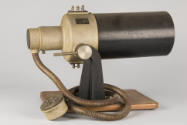
General Radio Company
Date: circa 1931
Accessories: 2 small felt lined arcs with 2 protruding arms.
Object number: RS0261


Radio Research Laboratory
Date: 1945
Accessories: cable
Object number: 1997-1-0077


Kaiser Aircraft & Electronics Corporation
Date: circa 1955
Accessories: various historical articles
Object number: 1997-1-0628