


quartz monochromator
Datecirca 1950
Inventory Number1997-1-0256
ClassificationMonochromator
Subject
Maker
Cambridge Thermionic Corporation
1930s-present
Maker
Electron Arc, Inc.
fl. 1943
Inventor
Prof. Cornelius S. Hurlbut Jr.
1906 - 2005
User
Mineralogical Museum, Harvard University
founded circa 1775
Cultural Region
Place of Origin
Dimensionswithout cord: 34.5 × 15 × 15.2 cm (13 9/16 × 5 7/8 × 6 in.)
Material
Accessories100W DC power supply (see 2007-1-0085)
DescriptionThis device has three parts. The first is a tall rectangular box, finished with black crackle. On its front face, the box has a nameplate, underneath which is a circular scale (perhaps missing a dial?) and another mysterious circular component.
The second component of this device, another box, hovers atop the first. (They are connected in back by a metal component.) This box is metallic and is slightly wider than the box underneath it. The front, and its adjacent grated sides, are removable. (Six tiny screws, absent, were meant to affix the front to the rest of the box.) On the top of the metallic box is a nameplate for Electronic Arc, Inc.
There are two major components inside the metallic box. The first, on the left, is a glass bulb (a vacuum tube), shaped like a rounded pyramid. From the top of the bulb, an orange wire runs to the component on the right. This component consists of what looks like a conveyor belt with a metal spool on one end, and a black box on the other.
A number of wires emanate from the black box and up through the teal-colored cover of the metallic box. Here, it connects to the third component: a black insulated wire plugged into an outlet. This wire is long enough to run down to the ground and coil a few times before it terminates in a three-pronged plug.
The second component of this device, another box, hovers atop the first. (They are connected in back by a metal component.) This box is metallic and is slightly wider than the box underneath it. The front, and its adjacent grated sides, are removable. (Six tiny screws, absent, were meant to affix the front to the rest of the box.) On the top of the metallic box is a nameplate for Electronic Arc, Inc.
There are two major components inside the metallic box. The first, on the left, is a glass bulb (a vacuum tube), shaped like a rounded pyramid. From the top of the bulb, an orange wire runs to the component on the right. This component consists of what looks like a conveyor belt with a metal spool on one end, and a black box on the other.
A number of wires emanate from the black box and up through the teal-colored cover of the metallic box. Here, it connects to the third component: a black insulated wire plugged into an outlet. This wire is long enough to run down to the ground and coil a few times before it terminates in a three-pronged plug.
Signedon nameplate: QUARTZ / MONOCHROMATOR / MFG BY / CAMBRIDGE THERMIONIC CORP / CAMB. MASS / MODEL B U.S.A.
on nameplate, top of the metallic box: Electronic Arc, Inc.
Curatorial RemarksSee 2007-1-0085 (a DC Power Supply) and information on tag with it. This monochromator may have been "Produced at Harvard by Cornelius Hurlbut c. 1950 (?)." The two may belong together.
FunctionA monochromator is an optical device that filters and transmits a narrow band of wavelengths of light or other radiation.
Two major uses of a monochromator are directing monochromatic light at a sample in order to gauge a possible reaction, and directing white light at a sample and using the monochromator to analyze the reflected or transmitted light.
One characteristic of filtered light is its dispersion, which is defined as the width of the band of colors per unit of slit width. (This ratio depends on the wavelength of the light selected.) For a quartz monochromator, the prism regulating the slit width is made of quartz.
Two major uses of a monochromator are directing monochromatic light at a sample in order to gauge a possible reaction, and directing white light at a sample and using the monochromator to analyze the reflected or transmitted light.
One characteristic of filtered light is its dispersion, which is defined as the width of the band of colors per unit of slit width. (This ratio depends on the wavelength of the light selected.) For a quartz monochromator, the prism regulating the slit width is made of quartz.
ProvenanceDelivered to the CHSI on 5/26/93 by Bill Metropolis. Gift from the Mineralogical Museum, Harvard University.
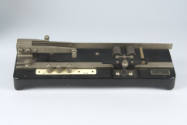

ACME Apparatus Company
Date: 1930-1950
Accessories: handle; black cylindrical component; wrapping newspaper
Object number: 1997-1-0516

Walter Balcke
Date: 1955
Accessories: mahogany box with plexiglass lid; pencil; eraser; box of lead; putty ball; cleaning cloth; cardboard instruction card
Object number: 1997-1-1619

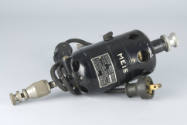
The W. M. Welch Scientific Company
Date: 1910-1940
Object number: 1996-1-0484


Jefferson Physical Laboratory, Harvard University
Date: circa 1940
Object number: 1997-1-0229


Iomec, Incorporated - Digitronics Division
Date: circa 1974
Accessories: paper punch-tape program stored in a plastic bag with the instrument
Object number: 1998-1-0017

Department of Physics, Harvard University
Date: 1930-1940
Accessories: bakelite case
Object number: 0448


See also/See also
