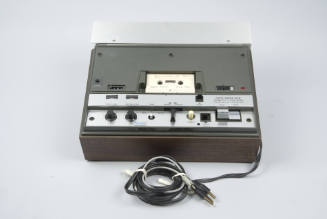
electrowriter model 21 transmitter
Date1971-1973
Inventory Number2004-1-0223
ClassificationCommunications Device
Subject
Maker
Victor Comptometer Corporation
1918 - 1977
User
Polaroid Corporation
1937-present
Owner
Edwin H. Land
1909 - 1991
Cultural Region
Place of Origin
Dimensions18.1 × 24.5 × 38 cm (7 1/8 × 9 5/8 × 14 15/16 in.)
Material
DescriptionThis electrowriter is essentially a fax machine, equipped with a free armpen that lets its user draw whatever s/he wishes on a moving paper roll (still in the machine). What this device transmits is picked up and printed by an electrowriter receiver (see 2004-1-0222). The plastic hood can be removed to see the interior mechanism. A data and a three-pronged electric cords are provided.
On the machine one can read the following on a taped piece of paper: "Sketch your imagery / Write out technical / terms when spelling / is not obvious / Please put the pen / down when not actually writing or pointing / Put the pen down before / stopping the deck."
Other markings: "5A"; "VETS.SPL."; "CODE/OO9.10"; "Ranged / 5173 / Checked / 4/75 / VETS / Transmitter / EXP.'
On the machine one can read the following on a taped piece of paper: "Sketch your imagery / Write out technical / terms when spelling / is not obvious / Please put the pen / down when not actually writing or pointing / Put the pen down before / stopping the deck."
Other markings: "5A"; "VETS.SPL."; "CODE/OO9.10"; "Ranged / 5173 / Checked / 4/75 / VETS / Transmitter / EXP.'
In Collection(s)
Signedon front: VICTOR COMPTOMETER CORPORATION
Curatorial RemarksThe senior scientist who worked on this project at Polaroid between 1971 and 1976 was Stewart W. Wilson. His resume posted on the web (see <a href="http://www.eskimo.com/~wilson/resume.pdf" target="_blank">here</a>) mentions that he
"Invented, developed, produced, and marketed the Interactive Lecture System (ILS), an individual learning system which approximates a personal, branching interaction with an articulate scientist or teacher on a topic of mutual
interest, including answers by the speaker to questions as they arise.
Contracted with and directed the making of Interactive Lecture recordings by scientists such as Carl Sagan and Philip Morrison. Tested system with students from M.I.T., Harvard, and Boston University.
For the ILS’s graphic channel, which allows formulas and sketches in the teacher’s own hand to play back from the second track of the tape, invented and implemented a compensator unit which totally eliminates tape flutter effects from the writing.
Directed manufacture of the ILS, introduced as a Polaroid product at shows such as the American Physical Society’s annual meeting, and marketed it nationally to schools and colleges."
FunctionEvidently part of an early distance learning system, and used in tandem with a receiver device. The transmitter allows its user to draw small figures or spell technical terms, which are then plotted by a receiver, providing a sort of virtual blackboard to accompany a spoken lecture.
This electrowriter transmitter was part of at least two patents granted to the Polaroid Corporation: patent number 3,942,268 and number 3,971,141. The first was filed on 2 October 1972 and granted on 9 March 1976; the second one was filed on 15 April 1974 and granted on 27 July 1976. The title of the first one is: "Methods and apparatus for interactive communications"; the title of the second one is: "Method for interactive communications."
The abstract of both patents are almost identical. The first one reads thus: "A method of communication, and apparatus for communication, in which a user is provided with a set of recordings, a device for reproducing the recordings, and a map comprising indicia correlating the recordings so that the recordings from the set may be reproduced in a sequence determined by the user."
In the description of both patents, one can read regarding this instrument: "Preferably, in the process of recording both questions and answers, the lecturer is given the facility of accompanying his remarks with graphic illustrations such as sketches, a topic outline of points that he is covering, graphs, or the like, much as a professor would use a blackboard in the classroom. For this purpose, various visual aids may be employed, such as photographs, video recordings and the like, but I prefer to make use of a graphic recorder, such as the Electrowriter made and sold by the Victor Comptometer Corporation of Chicago, Illinois, as an adjunct to the lecturer's voice."
And also: "A tape recorder and a graphic recorder, such as an Electrowriter receiver, are provided to the student. Typically, he will then place the first lecture tape on the recorder, and begin to listen to it. He may continue to listen until he has gone through the entire lecture, but, due to the interaction permitted by the recordings, experience has shown it to be very unlikely he will do this."
This electrowriter transmitter was part of at least two patents granted to the Polaroid Corporation: patent number 3,942,268 and number 3,971,141. The first was filed on 2 October 1972 and granted on 9 March 1976; the second one was filed on 15 April 1974 and granted on 27 July 1976. The title of the first one is: "Methods and apparatus for interactive communications"; the title of the second one is: "Method for interactive communications."
The abstract of both patents are almost identical. The first one reads thus: "A method of communication, and apparatus for communication, in which a user is provided with a set of recordings, a device for reproducing the recordings, and a map comprising indicia correlating the recordings so that the recordings from the set may be reproduced in a sequence determined by the user."
In the description of both patents, one can read regarding this instrument: "Preferably, in the process of recording both questions and answers, the lecturer is given the facility of accompanying his remarks with graphic illustrations such as sketches, a topic outline of points that he is covering, graphs, or the like, much as a professor would use a blackboard in the classroom. For this purpose, various visual aids may be employed, such as photographs, video recordings and the like, but I prefer to make use of a graphic recorder, such as the Electrowriter made and sold by the Victor Comptometer Corporation of Chicago, Illinois, as an adjunct to the lecturer's voice."
And also: "A tape recorder and a graphic recorder, such as an Electrowriter receiver, are provided to the student. Typically, he will then place the first lecture tape on the recorder, and begin to listen to it. He may continue to listen until he has gone through the entire lecture, but, due to the interaction permitted by the recordings, experience has shown it to be very unlikely he will do this."
ProvenanceThis object belonged to Edwin H. Land and came from the Rowland Institute, Harvard University. Gift of the Edwin H. Land Family.

Victor Comptometer Corporation
Date: 1971-1973
Accessories: circuitry schematic (in instrument file)
Object number: 2004-1-0222

3M Company
Date: 1971-1972
Accessories: "VOICE/WRITER DECK - COMPENSATOR SWITCHING DIAGRAM" in instrument file.
Object number: 2004-1-0224

L. E. Knott Apparatus Company
Date: late 19th-early 20th Century
Object number: 1998-1-0458


Western Electric Company
Object number: RS0149

John Cuthbertson
Date: 1770-1815
Accessories: brown storage box, descriptive tag, thin strip of paper in box with the inscription "lucernal microscope" in David P. Wheatland's handwriting (which refers to figs. 47-48 and 51 in this series), page from the book "Old Science and Medicine" with a photographic copy of the first print from this series, entitled "The Large Electric Machine at Haarlem."
Object number: 1998-1-1087

R. & J. Beck
Date: 1876
Accessories: oculars (2) in microscope; Darker's selenite retarding filters (3); wheel diaphragm; mechanical rotary stage; stage slider. Other accessories are in the case (1122b), including monocular draw tube; oculars (3); objectives in cans (5); empty can; Lieberkühn; polarizing set; slides; camera lucidas (2); etc.; plus a Beck patent substage condenser (1122c); and apertometer (1122d).
Object number: 1122a

Edmund Culpeper
Date: circa 1730
Accessories: 6 objectives for screw-barrel microscope; 3 objectives for compound body; 1 lieberkuhn; 1 opaque attachment; brass box; 2 ivory slides, 1 brass wet-cell slide; tweezer; ivory handle; glass specimen fish tube; storage box; instruction booklet by Culpeper (stored in instrument file).
Object number: 1173

Boston Optical Works
Date: 1868
Accessories: Slide for 4 objects
Object number: 1211


Hans W. Egli
Date: circa 1925
Accessories: brush
Object number: 1996-1-0166

See also/See also