


earth inductor
Date1871-1898
Inventory Number1997-1-0668
ClassificationInductance
Subject
Maker
Buff & Berger
1871 - 1898
Cultural Region
Place of Origin
Dimensions50.5 × 57.6 × 41.7 cm (19 7/8 × 22 11/16 × 16 7/16 in.)
Material
DescriptionCircular flip coil with three binding posts attached to a square wooden frame hinged on two vertical wooden arms coming from the instrument's wooden base. The wooden frame has a large knob on top for manipulation. The base is rectangular and has an empty placard holder.
On one of the ends of the axles that turn the frame is a brass dial with 0-90-0-90 degree angle measurement marks and a double pointer that points to the same angle on opposite ends of the dial. This dial indicates the inclination of the wooden frame and coil.
On one of the ends of the axles that turn the frame is a brass dial with 0-90-0-90 degree angle measurement marks and a double pointer that points to the same angle on opposite ends of the dial. This dial indicates the inclination of the wooden frame and coil.
SignedOn brass knob on side of instrument BUFF & BERGER / BOSTON
Curatorial RemarksContrary to the other two earth inductors in the collection, this one has the coil fixed to the wooden frame, which is the only moving part.
see 1997-1-0643 and 1997-1-1670.
FunctionFrom the website of the physics department at Kenyon College available here:
"The Earth Inductor is a flip coil used to measure the magnitude and direction of the earth's magnetic field. The rotating coil is quickly flipped through 180 degrees, and the output is fed to a ballistic galvanometer. This device, with a long period of oscillation, measures the total charge delivered by the induced EMF; the charge is then proportional to the magnitude of the magnetic field threading the coil.
The experiment is done with the coil horizontal (to find the vertical component of the earth's field) and vertical (to find the horizontal component). The direction and net field can then be readily calculated."
Note: In this particular instrument, the coil is attached to the wooden frame and cannot rotate separately from it. This makes it a rudimentary imitation of others with an independently rotating coil. The square frame does not serve a specific purpose other than resemblance to more complex earth inductors.
"The Earth Inductor is a flip coil used to measure the magnitude and direction of the earth's magnetic field. The rotating coil is quickly flipped through 180 degrees, and the output is fed to a ballistic galvanometer. This device, with a long period of oscillation, measures the total charge delivered by the induced EMF; the charge is then proportional to the magnitude of the magnetic field threading the coil.
The experiment is done with the coil horizontal (to find the vertical component of the earth's field) and vertical (to find the horizontal component). The direction and net field can then be readily calculated."
Note: In this particular instrument, the coil is attached to the wooden frame and cannot rotate separately from it. This makes it a rudimentary imitation of others with an independently rotating coil. The square frame does not serve a specific purpose other than resemblance to more complex earth inductors.


Buff & Berger
Date: circa 1880
Accessories: mahogany case; sunshade; screws; dust cover
Object number: 5143a

Buff & Berger
Date: circa 1880
Accessories: mahogany case; sunshade; screws; dust cover; tripod (5144b)
Object number: 5144a

Buff & Buff Manufacturing Company
Date: circa 1905
Accessories: wood case; leather case; right-angle prism; plumb bob; oil flask; tripod (5174b)
Object number: 5174a


Buff & Berger
Date: 1871-1898
Accessories: plane table compass; sun shade; dust cap
Object number: 5153

French
Date: circa 1880
Accessories: protecting case with glass window
Object number: DW0095

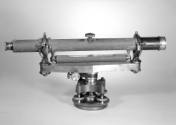
Buff & Berger
Date: circa 1890
Accessories: mahogany case with lock (key not found); leather strap; screwdriver; dust cover; sunshade; tripod, see 5149b
Object number: 5149a
See also/See also

