


Wimshurst electrostatic machine
Datecirca 1890
Inventory Number1997-1-0644a,b,c
ClassificationElectrostatic Machine
Subject
Maker
James W. Queen & Company
1853 - 1893
User
Department of Physics, Harvard University
founded 1884
Cultural Region
Place of Origin
Dimensions36.9 × 65.4 × 41.5 cm (14 1/2 × 25 3/4 × 16 5/16 in.)
Material
Accessoriestwo fragments of glass wheel bound separately as (b) and (c)
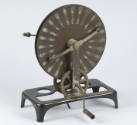
DescriptionA rectangular base supports a cylinder on which is fixed an axle. The axle has two separate set of pulleys linked to the grooved wheel on the side, which is turned by a hand crank. Pieces of the original leather straps are still there. The axle was made for two glass discs to rotate in opposite directions. Both are broken. They have several sectors along they edges covered in what appears to be gold foil. Brushes are used to gather electrostatic charges. On the front are two sliding electrodes, one hand insulated so they can be handled.
The base has an old Harvard inventory number: 8-41. There are also two letters: EQ.
The base has an old Harvard inventory number: 8-41. There are also two letters: EQ.
Signedon plaque, script: Jas. W. Queen & Co. / Philada
FunctionThis electrostatic machine invented in the early 1880s uses two glass discs spinning in opposite directions to generate electric charges. The two sliding electrodes found at the front of the instrument are used to distribute charges to other instruments. When put in close-enough distance to one another, the electrodes will produce a small lightning, which results in discharging the apparatus. The closer they are, more frequent will the lightning be since it takes less charge to bridge a short air gap than it takes for a longer one.
For more information, go to the following website.
For a short YouTube movie on how such a machine works, go to the following website.
For more information, go to the following website.
For a short YouTube movie on how such a machine works, go to the following website.
ProvenanceFrom the Department of Physics, Harvard University.

Thomas Hall
Date: circa 1890
Accessories: pulley rope
Object number: 1997-1-1423


French
Date: circa 1890
Accessories: Leyden jars (2)
2 rubber pulley belts
Object number: DW0890
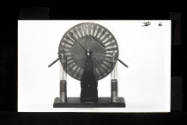

Central Scientific Company
Date: circa 1940
Accessories: 2 Leyden condensers made of Pyrex
One rubber **gutta percha?** pulley, rotted.
Object number: 1997-1-0634


Charles Chardin
Date: 1870-1900
Accessories: key; mahogany case
Object number: DW0829


