


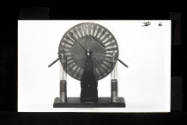
Wimshurst electrostatic machine
Datecirca 1910
Inventory NumberDW0006
ClassificationElectrostatic Machine
Subject
Maker
Radiguet & Massiot
founded 1899
Inventor
James Wimshurst
1832 - 1903
Cultural Region
Place of Origin
Dimensions34 × 30.1 × 15.8 cm (13 3/8 × 11 7/8 × 6 1/4 in.)
Material
DescriptionTwo contrarotating discs, possibly made of hardened rubber or ebonite, mounted on metal pillars on a black-enameled wood base. Distributed around the circumferences of the discs are narrow strips of tinfoil with longitudinal axes in the radial direction. On the same bearing as the large wheel is a smaller wheel at the hub for a pulley. The pulleys are wrapped around larger wheels mounted toward the bottoms of the pillars. Those wheels are turned by a metal crank with a rounded celluloid handle. One of the pulleys would be twisted into a figure eight to make the wheel rotate in the opposite direction to the first.
On one side of each of the wheels is a neutralizing rod with several bends in its length and fine wire contact brushes at each end.
On the other side of the wheels is another neutralizing rod of the same design. Also on that side are two glass Leyden jars sitting in two metal cups screwed to either side of the base. The jars have red strips around their tops. Attached to the caps of the jars is a series of metal spheres. Attached to one sphere is a fork straddling the discs with collecting combs touching the discs at each of its ends. Also attached to the caps of the jars are nickel-plated discharge rods, with a handle on one end and a sphere on the other. The Leyden jars are glass coated with silver on the bottom of the inside and outside. They have nickel-plated rods extending from the caps to the inner coating. Also rotating on the rods on either end of the bar are discharge rods. On one end of the rod is an ebonite handle; on the other is a pair of balls, the one on the tip slightly smaller than the one beneath it.
On one side of each of the wheels is a neutralizing rod with several bends in its length and fine wire contact brushes at each end.
On the other side of the wheels is another neutralizing rod of the same design. Also on that side are two glass Leyden jars sitting in two metal cups screwed to either side of the base. The jars have red strips around their tops. Attached to the caps of the jars is a series of metal spheres. Attached to one sphere is a fork straddling the discs with collecting combs touching the discs at each of its ends. Also attached to the caps of the jars are nickel-plated discharge rods, with a handle on one end and a sphere on the other. The Leyden jars are glass coated with silver on the bottom of the inside and outside. They have nickel-plated rods extending from the caps to the inner coating. Also rotating on the rods on either end of the bar are discharge rods. On one end of the rod is an ebonite handle; on the other is a pair of balls, the one on the tip slightly smaller than the one beneath it.
Signedlabel on base: RADIGUET & MASSOIT / CONSTRUCTEUR / 13 & 15 Bould des Filles du Calvaire, PARIS
FunctionThe machine is self-exciting, which means no external charge is necessary to set it in motion. Any slight difference in charge between the two halves of the discs is sufficient. Suppose there is slight positive charge on one half of each disc. When a carrier on that half of the disc passes the contact for the neutralizing rod, that rod passes a negative charge from the carrier on the negative side to the positive carrier. Due to the influence of the positive charge on the other disc, the neutralizing rod does not simply discharge the two carriers. Rather, it actually conducts enough charge to produce a net negative charge to that carrier.
The discs are always divided into two halves by the neutralizing rods, one positive, one negative. Because the rods are at right angles to one another, the device ends up with four different charge relationships in four different quadrants. Two of the quadrants have opposite charges, and two have like charges. The collecting brushes are positioned on the quadrants with like charges, so each one collects only one charge, which can be stored in the Leyden jars.
The rods with the balls on them are the discharge rods, most likely to discharge the Leyden jars, either to make the instrument safer to touch or for demonstration purposes. Wimshurst machines were often used to excite X-ray tubes.
The discs are always divided into two halves by the neutralizing rods, one positive, one negative. Because the rods are at right angles to one another, the device ends up with four different charge relationships in four different quadrants. Two of the quadrants have opposite charges, and two have like charges. The collecting brushes are positioned on the quadrants with like charges, so each one collects only one charge, which can be stored in the Leyden jars.
The rods with the balls on them are the discharge rods, most likely to discharge the Leyden jars, either to make the instrument safer to touch or for demonstration purposes. Wimshurst machines were often used to excite X-ray tubes.
ProvenanceDavid Wheatland purchased from Roux-Devillas Paris, May 14, 1966 (lot 5/17).

French
Date: circa 1890
Accessories: Leyden jars (2)
2 rubber pulley belts
Object number: DW0890

Central Scientific Company
Date: circa 1940
Accessories: 2 Leyden condensers made of Pyrex
One rubber **gutta percha?** pulley, rotted.
Object number: 1997-1-0634

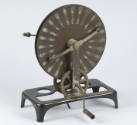


Thomas Hall
Date: circa 1890
Accessories: pulley rope
Object number: 1997-1-1423


John Cuthbertson
Date: 1770-1815
Accessories: brown storage box, descriptive tag, thin strip of paper in box with the inscription "lucernal microscope" in David P. Wheatland's handwriting (which refers to figs. 47-48 and 51 in this series), page from the book "Old Science and Medicine" with a photographic copy of the first print from this series, entitled "The Large Electric Machine at Haarlem."
Object number: 1998-1-1087


Adix Company
Date: circa 1905
Accessories: imitation leather covered, velvet and satin lined case
Object number: DW0325
