


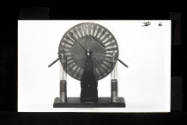
Holtz electrostatic machine with opposite rotating plates
Datecirca 1830
Inventory NumberDW0003
ClassificationElectrostatic Machine
Subject
Cultural Region
Dimensions28.5 × 57.2 × 47 cm (11 1/4 × 22 1/2 × 18 1/2 in.)
Material
DescriptionA pair of rotating glass discs (broken) turned by a crank mounted on a varnished, pear-shaped wooden base.
Glued to the narrow part of the base is a bearing with a flared bottom. The bearing holds two separate axles for wooden wheels. The drive wheel has a handle mounted halfway out from the center. The hubs are made of brass, with a piece of cork placed on the center of the drive wheel. The top of the bearing is glued to a rectangular wooden shaft whose other end houses one of the axles of the plates. On this shaft over the wheel bearing is a brass knob.
The plates are concentric and mounted on separate, but concentric, vertical brass axles. On the top and bottom of the axle are short spools around which a belt can be threaded.
The wheels have tinfoil strips arrayed around the circumference, their longitudinal axes pointing in a radial direction.
On all four corners of the larger part of the base are brass pillars that freely pivot in wooden cups. The pillars on both sides of the base are connected at the top by arching brass rods. The left pillar of each pair has a brass rod with a ball on the end facing inward and a rounded wooden handle on the end facing outward. Attached perpendicularly in the middle of each pillar is a collecting comb. The pillar in the left front corner has a comb underneath the plates; the one in the left rear corner has a comb over the plates; the one in the right rear corner has combs both over and underneath the plates, and the one in the right front corner has a comb over the plates.
The cups in the left side have holes in the sides for brass rods. In one of them is a U-shaped brass rod. The other cup is most likely missing one.
Glued to the narrow part of the base is a bearing with a flared bottom. The bearing holds two separate axles for wooden wheels. The drive wheel has a handle mounted halfway out from the center. The hubs are made of brass, with a piece of cork placed on the center of the drive wheel. The top of the bearing is glued to a rectangular wooden shaft whose other end houses one of the axles of the plates. On this shaft over the wheel bearing is a brass knob.
The plates are concentric and mounted on separate, but concentric, vertical brass axles. On the top and bottom of the axle are short spools around which a belt can be threaded.
The wheels have tinfoil strips arrayed around the circumference, their longitudinal axes pointing in a radial direction.
On all four corners of the larger part of the base are brass pillars that freely pivot in wooden cups. The pillars on both sides of the base are connected at the top by arching brass rods. The left pillar of each pair has a brass rod with a ball on the end facing inward and a rounded wooden handle on the end facing outward. Attached perpendicularly in the middle of each pillar is a collecting comb. The pillar in the left front corner has a comb underneath the plates; the one in the left rear corner has a comb over the plates; the one in the right rear corner has combs both over and underneath the plates, and the one in the right front corner has a comb over the plates.
The cups in the left side have holes in the sides for brass rods. In one of them is a U-shaped brass rod. The other cup is most likely missing one.
Signedunsigned
FunctionWhen the crank is turned in a clockwise direction, the upper wheel turns in a counterclockwise direction, the bottom in a clockwise direction (see pulley system description, below). A piece of negatively-charged vulcanite is placed opposite one of the top or bottom combs. A positive charge is induced on the upper plate and, when rotated, carried counterclockwise over to the comb on the diametrically opposite side. The influence of the upper plate's positive charge causes the bottom plate to develop a negative charge through the bottom collecting comb on the right rear corner. The bottom plate therefore carries a negative charge from the right rear to the left front corner. If the electrodes are brought into contact, the collecting comb of the left front corner discharges to the left rear corner and imparts a negative charge, due to the influence of the bottom plate, which is positively charged in that half of the plate. The charge increases rapidly. An extra comb on the right rear pillar is not typical of Holtz machines, but this may have been added to collect extra positive charge to flow to the positive electrode, since the right rear pillar is connected by wire to the left rear pillar, which is connected to the electrode.
Pulley system: The string is threaded through the top groove on the drive wheel, around the top spool of the vertical axle, and then through the groove on the top of the trailing wheel. The string passes around the rear of the trailing wheel and then out through the spool of the bottom axle. It winds around the axle and back into the groove at the bottom of the drive wheel, where it threads around the rear and joins the string in our initial position.
Pulley system: The string is threaded through the top groove on the drive wheel, around the top spool of the vertical axle, and then through the groove on the top of the trailing wheel. The string passes around the rear of the trailing wheel and then out through the spool of the bottom axle. It winds around the axle and back into the groove at the bottom of the drive wheel, where it threads around the rear and joins the string in our initial position.
ProvenanceDavid Wheatland purchased from Alain Brieux, Paris, April 19, 1962 (lot 5/8).


Thomas Hall
Date: circa 1890
Accessories: pulley rope
Object number: 1997-1-1423

English
Date: circa 1820
Accessories: wooden case
brass frame with points
glass arm
handle
broken glass (in package)
Object number: DW0504


English
Date: circa 1800
Accessories: Two insulated charge transfer wands.
Object number: 0014



French
Date: circa 1890
Accessories: Leyden jars (2)
2 rubber pulley belts
Object number: DW0890
