


Voss electrostatic machine
Date1850-1870
Inventory NumberDW0004
ClassificationElectrostatic Machine
Subject
Maker
O. Hempel et Cie
fl. 1850 - 1880
Cultural Region
Place of Origin
Dimensions35 × 54 × 34.5 cm (13 3/4 × 21 1/4 × 13 9/16 in.)
Material
DescriptionMost likely a Voss electrostatic generator similar to another item in the collection (1997-1-1423). Mounted on a varnished wooden base driven by a crank that turns a wheel mounted on a smaller, rounded wooden base that attaches to the main base through a screw that is fastened into an adjustable slot. The main base has four short tapered legs.
The crank drives a black wooden wheel connected by rope belt (included but not assembled) to a smaller wheel on the same axle as a pair of glass discs (missing).
The axle is mounted on a wooden pillar with a rounded top. On the axle is a brass neutralizing rod with brushes on either end. At a 30° angle to that rod is another brass rod with collecting brushes on either end positioned over what would be the bottom left and top right tinfoil circles on the fixed disc (missing). Attached perpendicularly to these brushes are two brass rods with spheres at their ends. Insert through the centers of these spheres two nickel-plated rods with spheres on the ends facing inward and bowling-pin-shaped ebonite handles on the ends point outward. These are the electrodes which discharge when the potential difference between the two sides of the rotating plate (missing) has increased sufficiently.
On the two front corners of the base are two binding posts. Toward the rear is a pair of notched posts to holed the fixed disc (missing). The pillar also has a rod attached perpendicularly near the top to hold the glass discs.
The crank drives a black wooden wheel connected by rope belt (included but not assembled) to a smaller wheel on the same axle as a pair of glass discs (missing).
The axle is mounted on a wooden pillar with a rounded top. On the axle is a brass neutralizing rod with brushes on either end. At a 30° angle to that rod is another brass rod with collecting brushes on either end positioned over what would be the bottom left and top right tinfoil circles on the fixed disc (missing). Attached perpendicularly to these brushes are two brass rods with spheres at their ends. Insert through the centers of these spheres two nickel-plated rods with spheres on the ends facing inward and bowling-pin-shaped ebonite handles on the ends point outward. These are the electrodes which discharge when the potential difference between the two sides of the rotating plate (missing) has increased sufficiently.
On the two front corners of the base are two binding posts. Toward the rear is a pair of notched posts to holed the fixed disc (missing). The pillar also has a rod attached perpendicularly near the top to hold the glass discs.
Signedon base: O. HEMPEL & CIE / PARIS
FunctionThe machine would consist of a fixed wheel and a rotating wheel, although they are both missing. One wheel would have two curved rectangular paper sectors with barbell-shaped tinfoil pieces mounted on them. The rotating wheel would have six brass rivets that would serve as charge carriers.
Consider a small potential difference on either side of the wheels. On the left side of the wheels is a net positive charge, on the right side a net negative. When the carrier passed the brushes of the neutralizing rod, it would discharge to the carrier on the other side. The potential is equalized, but due to the influence of the tinfoil strip, which also has a net positive charge, the carrier takes on a net negative charge. It carries this negative charge over to the brush on the right side. Because the brass rivet carrier has a higher potential than the foil strip, it discharges some of its negative charge to the foil.
It would then pass the other end of the neutralizing rod and acquire, due to the influence of the negatively charged foil strip, a net positive charge. It would then pass the brush on the right side where some of that positive charge would be passed to the foil strip. The potential would build up until the charge began to "leak."
When the carriers passed the collecting brushes, they would create a potential difference between the two electrodes. When the potential difference between the two sides became great enough, a spark would form between the two electrodes. If collecting devices were wired to the binding posts in front, they would collect the charge that had built up on either side.
Consider a small potential difference on either side of the wheels. On the left side of the wheels is a net positive charge, on the right side a net negative. When the carrier passed the brushes of the neutralizing rod, it would discharge to the carrier on the other side. The potential is equalized, but due to the influence of the tinfoil strip, which also has a net positive charge, the carrier takes on a net negative charge. It carries this negative charge over to the brush on the right side. Because the brass rivet carrier has a higher potential than the foil strip, it discharges some of its negative charge to the foil.
It would then pass the other end of the neutralizing rod and acquire, due to the influence of the negatively charged foil strip, a net positive charge. It would then pass the brush on the right side where some of that positive charge would be passed to the foil strip. The potential would build up until the charge began to "leak."
When the carriers passed the collecting brushes, they would create a potential difference between the two electrodes. When the potential difference between the two sides became great enough, a spark would form between the two electrodes. If collecting devices were wired to the binding posts in front, they would collect the charge that had built up on either side.
ProvenanceDavid Wheatland purchased from Alain Brieux, Paris, November 1965 (lot 23/6).

Thomas Hall
Date: circa 1890
Accessories: pulley rope
Object number: 1997-1-1423

French
Date: circa 1890
Accessories: Leyden jars (2)
2 rubber pulley belts
Object number: DW0890
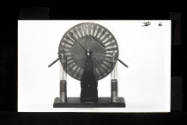


Central Scientific Company
Date: circa 1940
Accessories: 2 Leyden condensers made of Pyrex
One rubber **gutta percha?** pulley, rotted.
Object number: 1997-1-0634
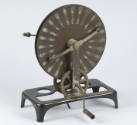


English
Date: circa 1820
Accessories: wooden case
brass frame with points
glass arm
handle
broken glass (in package)
Object number: DW0504

James W. Queen & Company
Date: circa 1890
Accessories: two fragments of glass wheel bound separately as (b) and (c)
Object number: 1997-1-0644a,b,c

See also/See also
