


plate electrical machine
Datecirca 1820
Inventory NumberDW0504
ClassificationElectrical Machine
Subject
Maker
English
?
Cultural Region
Dimensions46 x 31.5 x 14.5 cm (18 1/8 x 12 3/8 x 5 11/16 in.)
case: 49.5 x 37.5 x 25.8 cm (19 1/2 x 14 3/4 x 10 3/16 in.)
case: 49.5 x 37.5 x 25.8 cm (19 1/2 x 14 3/4 x 10 3/16 in.)
Material
Accessorieswooden case
brass frame with points
glass arm
handle
broken glass (in package)
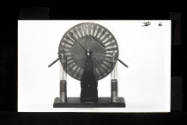
DescriptionEnglish-type electrostatic friction generator. Glass wheel mounted in a rectangular wooden frame. The sides of the frame are bearings for the brass wheel axle, which is turned by a crank which screws off and has a rounded wooden handle. The top and bottom of the frame have forks of thin rectangles lined with red felt on the side facing the glass. The felt pieces are spaced so that the glass rubs against the felt. A brass sphere is mounted at the top of the frame.
On the other side of the bearing from the axle is a slot for a glass arm that holds a collecting rod assembly. The other end of the glass inserts into a hole in the assembly.
The collecting rod assembly consists of a pair of bent brass rods joining at a closed brass tube with a handle culminating in a brass sphere. The ends of the tube are rounded and have holes in one side. At the ends of the rods are collecting combs mounted perpendicular to the rods at their ends. Each comb has a wood sphere at its end and two spikes protruding from the side normally facing the glass disc.
On the left front corner of the base is a glass cylinder with brass caps at either end and a brass rod and sphere connected to the top cap. Attached to the top of the assembly is another brass sphere.
The instrument is kept in a mahogany case with brackets to hold the pieces in place. Name plate is missing.
On the other side of the bearing from the axle is a slot for a glass arm that holds a collecting rod assembly. The other end of the glass inserts into a hole in the assembly.
The collecting rod assembly consists of a pair of bent brass rods joining at a closed brass tube with a handle culminating in a brass sphere. The ends of the tube are rounded and have holes in one side. At the ends of the rods are collecting combs mounted perpendicular to the rods at their ends. Each comb has a wood sphere at its end and two spikes protruding from the side normally facing the glass disc.
On the left front corner of the base is a glass cylinder with brass caps at either end and a brass rod and sphere connected to the top cap. Attached to the top of the assembly is another brass sphere.
The instrument is kept in a mahogany case with brackets to hold the pieces in place. Name plate is missing.
Signedunsigned
FunctionContact between two different substances facilitates an electrostatic charge. Because the surfaces are usually rough, there is less contact, and therefore less charge transfer, than if the surfaces were completely smooth. Rubbing the two substances together facilitates a greater buildup of charge. Nonconductors are better at holding the charge.
The glass disk is turned with the crank and rubs against the felt pieces at the top and the bottom of the bearing. The charge builds up on the glass. The collecting combs collect the charge, and the two arms conduct the charge to the cylinder at the end. The glass arm and the wood tips of the collecting combs serve as insulators that keep the charge from moving anywhere but the collecting tube.
The glass disk is turned with the crank and rubs against the felt pieces at the top and the bottom of the bearing. The charge builds up on the glass. The collecting combs collect the charge, and the two arms conduct the charge to the cylinder at the end. The glass arm and the wood tips of the collecting combs serve as insulators that keep the charge from moving anywhere but the collecting tube.
ProvenanceFrom Saul Moskowitz, Historical Technology, Inc., Marblehead, MA, March 28, 1975.


French
Date: circa 1890
Accessories: Leyden jars (2)
2 rubber pulley belts
Object number: DW0890


Thomas Hall
Date: circa 1890
Accessories: pulley rope
Object number: 1997-1-1423


Clemens Kohl
Date: after 1780
Object number: 1998-1-1105