


electrostatic machine
Date1840-1860
Inventory NumberDW0838
ClassificationElectrostatic Machine
Subject
Maker
French
?
Cultural Region
Dimensions44.6 × 59.1 × 33.1 cm (17 9/16 × 23 1/4 × 13 1/16 in.)
blue board box: 46.4 × 62.4 × 34.6 cm (18 1/4 × 24 9/16 × 13 5/8 in.)
blue board box: 46.4 × 62.4 × 34.6 cm (18 1/4 × 24 9/16 × 13 5/8 in.)
Material
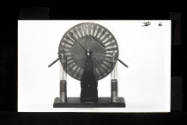
DescriptionFrench-type electrostatic friction generator. Glass wheel mounted in a rectangular wood frame. The sides of the frame are bearings for the wheel axle, which is turned by a crank with a metal rod for a handle. The hub of the wheel is brass. The top and bottom of the frame have forks with leather cushions on either side of the glass. The pieces are spaced so that the glass rubs against the leather. A brass sphere is mounted at the top of the frame.
The collector assembly consists of a pair of brass tubes, each mounted on glass rods with brass on their tops and the bases. The tubes each terminate on either end in a brass sphere and are connected on the far end by a rod with a sphere in the middle. Attached to the middle sphere by a rod is another brass sphere.
On the other side of each tube, straddling one side of the plate is a collecting comb consisting of two U-shaped rods terminating in brass spheres. Along the rods are spikes facing inward and almost touching the glass. The rods are each inserted into a hole in a brass spheres at one end of a brass tube.
The collector assembly consists of a pair of brass tubes, each mounted on glass rods with brass on their tops and the bases. The tubes each terminate on either end in a brass sphere and are connected on the far end by a rod with a sphere in the middle. Attached to the middle sphere by a rod is another brass sphere.
On the other side of each tube, straddling one side of the plate is a collecting comb consisting of two U-shaped rods terminating in brass spheres. Along the rods are spikes facing inward and almost touching the glass. The rods are each inserted into a hole in a brass spheres at one end of a brass tube.
Signedunsigned
Curatorial RemarksOriginally given a date of c.1860, but Turner's estimate of mid-19th century is probably better for a device like this.
FunctionContact between two different substances facilitates an electrostatic charge. Because the surfaces are usually rough, there is less contact, and therefore less charge transfer, than if the surfaces were completely smooth. Rubbing the two substances together facilitates a greater buildup of charge. Nonconductors are better at holding the charge.
The glass disk is turned with the crank and rubs against the sheepskin pieces at the top and the bottom of the bearing. The charge builds up on the glass. The U-shaped combs straddling the glass on either side collect the charge, which is conducted to the two tubes. The glass rods at the bottom serve as insulators to keep too much charge from "leaking" to the ground.
The glass disk is turned with the crank and rubs against the sheepskin pieces at the top and the bottom of the bearing. The charge builds up on the glass. The U-shaped combs straddling the glass on either side collect the charge, which is conducted to the two tubes. The glass rods at the bottom serve as insulators to keep too much charge from "leaking" to the ground.
ProvenanceDavid Wheatland purchased from Roux-Devillas Paris, May 1, 1963 (lot 1/10). Donated to CHSI May 12, 1988.

English
Date: circa 1820
Accessories: wooden case
brass frame with points
glass arm
handle
broken glass (in package)
Object number: DW0504


French
Date: circa 1890
Accessories: Leyden jars (2)
2 rubber pulley belts
Object number: DW0890


Thomas Hall
Date: circa 1890
Accessories: pulley rope
Object number: 1997-1-1423


Benjamin Martin
Date: circa 1766
Accessories: rope cord belt
glass globe
conducting pad
in folder: photographs, page containing description, history, and discussion of design, note from Ebenezer Gay regarding conservation work, excerpt from David Pingree Wheatland and I. Bernard Cohen, A Catalogue of Some Early Scientific Instruments at Harvard University (Cambridge, MA: Harvard University, 1949), woodcut with picture of instrument from B. Martin, Young Gentleman and Lady's Philosophy (1759): 139.
X-ray images of parts of the machine can be found in C1-A7.
Object number: 0013


French
Date: circa 1810
Accessories: ivory (?) dial broken off
Object number: DW0496