


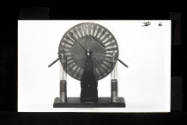
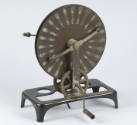
Ruhmkorff electrostatic machine
Date1890-1920
Inventory NumberDW0301
ClassificationElectrostatic Machine
Subject
Maker
L. Luizard
fl. 1890 - 1925
Cultural Region
Place of Origin
Dimensions124.5 x 69.2 x 47.4 cm (49 x 27 1/4 x 18 11/16 in.)
Material
DescriptionRuhmkorff Holtz-type electrostatic machine. Four yellow glass wheels mounted on a pair of iron bearings screwed into a rectangular table with a hole in the middle under the wheels.
The outer wheels are fixed, while the inner wheels are turned by a pulley. The drive wheel is wood with a groove for the robe and a rounded wooden handle, all mounted on an iron pillar. The train wheel is brass and shares an axle with the two moving wheels. The bearings are of curled iron work pattern and an "L" in the middle. One bearing is higher than the other to hold the top rubbing cylinder.
The inside wheels are fixed at three points by rubber-ridge cylinders mounted between glass rods. The two cylinders at the bottom are mounted between spherical wooden pillars, while the cylinder at the top is mounted on the rear bearing, as mentioned in the previous paragraph.
The two fixed wheels are slightly larger than the rotating wheels. On each side of the fixed wheels are holes next to paper carriers. The carriers each have two "teeth" protruding in a clockwise direction.
The collectors are mounted on a pair of glass rods, each with a brass base and brass cap terminating in spheres with tubes on either side. On one side of the sphere is a sphere with a Leyden jar hanging down from it. The jar is a hollow cylinder of browned glass with a hard-rubber and cork cap with two wires in the center connecting to the brass rod. The bottom of the cylinder is silvered on the inside and outside, the outside having a brass band around it.
Also connecting to the tube on that side of the sphere is T-piece screwed into it. One end of the T-piece ends in a hard rubber sphere. Into the other is inserted a brass collecting combs, which are rods curving around the wheels and lined with spikes.
Inserted into the other side of the brass tube is a brass discharge rod terminating in a brass sphere on one end and cylindrical ebonite handles.
The outer wheels are fixed, while the inner wheels are turned by a pulley. The drive wheel is wood with a groove for the robe and a rounded wooden handle, all mounted on an iron pillar. The train wheel is brass and shares an axle with the two moving wheels. The bearings are of curled iron work pattern and an "L" in the middle. One bearing is higher than the other to hold the top rubbing cylinder.
The inside wheels are fixed at three points by rubber-ridge cylinders mounted between glass rods. The two cylinders at the bottom are mounted between spherical wooden pillars, while the cylinder at the top is mounted on the rear bearing, as mentioned in the previous paragraph.
The two fixed wheels are slightly larger than the rotating wheels. On each side of the fixed wheels are holes next to paper carriers. The carriers each have two "teeth" protruding in a clockwise direction.
The collectors are mounted on a pair of glass rods, each with a brass base and brass cap terminating in spheres with tubes on either side. On one side of the sphere is a sphere with a Leyden jar hanging down from it. The jar is a hollow cylinder of browned glass with a hard-rubber and cork cap with two wires in the center connecting to the brass rod. The bottom of the cylinder is silvered on the inside and outside, the outside having a brass band around it.
Also connecting to the tube on that side of the sphere is T-piece screwed into it. One end of the T-piece ends in a hard rubber sphere. Into the other is inserted a brass collecting combs, which are rods curving around the wheels and lined with spikes.
Inserted into the other side of the brass tube is a brass discharge rod terminating in a brass sphere on one end and cylindrical ebonite handles.
Signedon name plate: L. LUIZARD / CONSTRUCTEUR / PARIS / 14, RUE DU CLOÎTRE NOTRE-DAME, 14
FunctionAccording to John Gray in Electrical Influence Machines (Whittaker, 1890), available here, "[t]o start the machine the electrodes are placed in contact, and the discs are turned in the proper direction, while an excited plate of vulcanite is placed between the fixed plates in contact with one of the field plates" (137).
Gray elaborates on the theory behind the machine's operation: "To start a duplex machine we shall assume that a positive charge is communicated to one of the four paper sectors. The influence of this charge will cause the two connected collecting combs to deposit a charge of negative electricity on the outer surface of the nearest disc, and a charge of positive electricity on the outer surface of the furthest disc. The charge on the surface of this latter disc induces a charge of positive electricity on the furthest end of the other sector which lies adjacent and parallel to the sector which received the original positive charge. Thus the charges on the parts of these adjacent sectors which lie opposite the ends of the neutralizing rods are both positive, and consequently negative electricity will be induced on the surface of both discs at the ends of the neutralizing rod, and carried round to charge the other pair of adjacent sectors with negative electricity. From the above explanation it is easy to see that the current in both discs will be in the same direction if there is a neutralizing rod on each disc" (137-138).
Gray elaborates on the theory behind the machine's operation: "To start a duplex machine we shall assume that a positive charge is communicated to one of the four paper sectors. The influence of this charge will cause the two connected collecting combs to deposit a charge of negative electricity on the outer surface of the nearest disc, and a charge of positive electricity on the outer surface of the furthest disc. The charge on the surface of this latter disc induces a charge of positive electricity on the furthest end of the other sector which lies adjacent and parallel to the sector which received the original positive charge. Thus the charges on the parts of these adjacent sectors which lie opposite the ends of the neutralizing rods are both positive, and consequently negative electricity will be induced on the surface of both discs at the ends of the neutralizing rod, and carried round to charge the other pair of adjacent sectors with negative electricity. From the above explanation it is easy to see that the current in both discs will be in the same direction if there is a neutralizing rod on each disc" (137-138).
ProvenanceDavid Wheatland purchased from Alain Brieux, Paris, April 1967 (part of lot 27/5).


French
Date: circa 1890
Accessories: Leyden jars (2)
2 rubber pulley belts
Object number: DW0890

Thomas Hall
Date: circa 1890
Accessories: pulley rope
Object number: 1997-1-1423

Central Scientific Company
Date: circa 1940
Accessories: 2 Leyden condensers made of Pyrex
One rubber **gutta percha?** pulley, rotted.
Object number: 1997-1-0634


Benjamin Martin
Date: circa 1766
Accessories: rope cord belt
glass globe
conducting pad
in folder: photographs, page containing description, history, and discussion of design, note from Ebenezer Gay regarding conservation work, excerpt from David Pingree Wheatland and I. Bernard Cohen, A Catalogue of Some Early Scientific Instruments at Harvard University (Cambridge, MA: Harvard University, 1949), woodcut with picture of instrument from B. Martin, Young Gentleman and Lady's Philosophy (1759): 139.
X-ray images of parts of the machine can be found in C1-A7.
Object number: 0013


English
Date: circa 1820
Accessories: wooden case
brass frame with points
glass arm
handle
broken glass (in package)
Object number: DW0504