


undulator (EEG machine)
Datecirca 1934
Inventory Number1997-1-0169a
ClassificationElectroencephalograph
Subject
User
Harvard Medical School
founded 1782
Maker
Western Union Company
1851-present
Maker(motor)
Westinghouse Electric & Manufacturing Company
1886 - 1945
Maker
Hallowell Davis
1896 - 1992
Maker
E. Lovett Garceau
1906 - 1966
Cultural Region
Place of Origin
Place of Use
Dimensions22.5 x 32 x 30.5 cm (8 7/8 x 12 5/8 x 12 in.)
Material
Accessoriespowercords (2); rubber tubing; undulator tape.
DescriptionE. L. Garceau and H. Davis published an article detailing how they modified a Western Union undulator for the purposes of recording electrical potentials in the brain. Referring to this particular object they wrote:
"Through the courtesy of Mr. J.W. Milnor of the Western Union Telegraph Company, several Boehme type 2-A undulators were obtained and converted to our uses. The 'undulator' comprises a moving magnetic element which operates a small silver siphon writing on a moving strip of paper. As in the case of all mechanical oscillographs, the amplitude of the response is a function of the frequency of the oscillations, but it was found possible, by increasing the restoring force of the undulator springs and adjusting the pressure of the siphon on the tape to provide just-critical damping, to obtain good records at all frequencies up to 40 cycles per second. The relative suppression of higher frequencies has real practical advantages in that it greatly reduces any 60 cycle artefact, which often appears if the subject is not in a shielded room, and minimizes the disturbance due to muscular action potentials from the neck or jaw. The width of the paper tape was increased from 3/8 to 5/8 inch (0.96 to 1.6 cm.) so that larger amplitudes than usual could be used. This also provided an ample margin for a second pen to record time intervals of one second and also signals indicating stimulation, activity of the subject and the like. The speed of the tape can be adjusted by a positive friction gear from 1/2 to 5 inches (1.27 to 12.7 cm.) per second."
E.L. Garceau and H. Davis, "An Ink-Writing Electro-Encephalograph," Archives of Neruology and Psychiatry, Vol. 34, no. 6 (1935) 1292-1294.
"Through the courtesy of Mr. J.W. Milnor of the Western Union Telegraph Company, several Boehme type 2-A undulators were obtained and converted to our uses. The 'undulator' comprises a moving magnetic element which operates a small silver siphon writing on a moving strip of paper. As in the case of all mechanical oscillographs, the amplitude of the response is a function of the frequency of the oscillations, but it was found possible, by increasing the restoring force of the undulator springs and adjusting the pressure of the siphon on the tape to provide just-critical damping, to obtain good records at all frequencies up to 40 cycles per second. The relative suppression of higher frequencies has real practical advantages in that it greatly reduces any 60 cycle artefact, which often appears if the subject is not in a shielded room, and minimizes the disturbance due to muscular action potentials from the neck or jaw. The width of the paper tape was increased from 3/8 to 5/8 inch (0.96 to 1.6 cm.) so that larger amplitudes than usual could be used. This also provided an ample margin for a second pen to record time intervals of one second and also signals indicating stimulation, activity of the subject and the like. The speed of the tape can be adjusted by a positive friction gear from 1/2 to 5 inches (1.27 to 12.7 cm.) per second."
E.L. Garceau and H. Davis, "An Ink-Writing Electro-Encephalograph," Archives of Neruology and Psychiatry, Vol. 34, no. 6 (1935) 1292-1294.
Signedtag on wooden base: Property of / Countway Library / Harvard, Medical School;
tag on metal rectangular part: "UNDULATOR" / First ink recording of EEG in the world 1934 / DR. HALLOWELL DAVIS / DR. ALEXANDER FORBES / HARVARD MEDICAL SCHOOL;
on plate attached to small brass object: SYNCHRONOUS MOTOR / WARREN TELECHRON CO. [the rest is illegibile?];
on plate attached to large metal object: Westinghouse [the rest is illegible?]
Inscribedhandwritten on torn piece of undulator tape inside of drawer: [illegible?];
in ink on the carton in which instrument was packed: First ink recording of EEG in the World 1934.
Curatorial RemarksAlso found in the box in which instrument was stored were 1997-1-0170a-c and a pamphlet for Eastern Association of Electroencephalographers March 1971.
FunctionThis Western Union ink-writing undulator was used in auditory studies as well as in recording the brain waves of animal and human subjects. The undulator (also occasionally referred to as a siphon or syphon recorder) was originally designed to record incoming and outgoing telegraphic messages. Amplified current deflected magnets in the device which caused the ink-writing mechanism to shift accordingly. According to Donald B. Lindsley, psychologist and experimental subject in the Department of Physiology at Harvard during the 1930s, "most of the equipment [in the lab] was for auditory studies....but it was also used for recording brain waves. They could be recorded on the oscilloscope, but for continuous recordings were traced on 1/2-inch paper tape by a single inkwriting pen of the Western Union Undulator device mounted just above the oscilloscope." This particular undulator was designed to be portable and to record continuous data without the need of an attendant to adjust the machine or tend to the paper tape.
For more information:
Donald B. Lindsley, "Average Evoked Potentials: Achievements, Failures and Prospects,” in Average Evoked Potentials: Methods, Results, and Evaluations, ed. Emanuel Donchin and Donald B. Lindsley. (Washington, Scientific and Technical Information Division, National Aeronautics and Space Administration, 1969), 1-43.
E.L. Garceau and H. Davis, "An Ink-Writing Electro-Encephalograph," Archives of Neruology and Psychiatry, Vol. 34, no. 6 (1935) 1292-1294.
For more information:
Donald B. Lindsley, "Average Evoked Potentials: Achievements, Failures and Prospects,” in Average Evoked Potentials: Methods, Results, and Evaluations, ed. Emanuel Donchin and Donald B. Lindsley. (Washington, Scientific and Technical Information Division, National Aeronautics and Space Administration, 1969), 1-43.
E.L. Garceau and H. Davis, "An Ink-Writing Electro-Encephalograph," Archives of Neruology and Psychiatry, Vol. 34, no. 6 (1935) 1292-1294.
ProvenanceFrom Countway Library, Harvard Medical School.
Historical AttributesThis instrument, developed by E.L. Garceau and H Davis, was the first one that graphically recorded an electroencephalogram (EEG).

Grass Instrument Company
Date: 1971
Object number: 1997-1-0169c
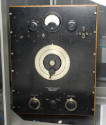
General Radio Company
Date: circa 1935
Accessories: power cord
Object number: 1997-1-0355


George Washington Pierce
Date: 1937
Object number: 1998-1-0951b


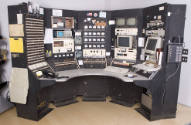
Harvard Cyclotron Laboratory
Date: 1947-2002
Object number: 2003-1-0291


Cruft Laboratory, Harvard University
Date: ca. 1920-1925
Object number: RS0912

Leach Relay Company
Date: 1890-1930
Object number: RS0531

Hammond Typewriter Company
Date: circa 1923
Accessories: four Hammond type shuttles for different type faces, each with a wooden storage box; four laminated paper rectangles with symbol placement guide; instruction book, instruction sheets, advertisements, and correspondence (in object file)
Object number: 1996-1-0373


