


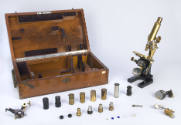
Pritchard achromatic compound microscope
Date1835-1840
Inventory Number1088a
ClassificationMicroscope
Subject
Maker
Andrew Pritchard
1804 - 1882
User
Peabody Museum of Salem
1799-1992
Cultural Region
Place of Origin
Place of Use
Dimensionscase: 29.5 × 36 × 25 cm (11 5/8 × 14 3/16 × 9 13/16 in.)
Material
Accessoriesobjectives (4); oculars (6); lieberkühns (4); stage forceps; bull's eye condenser on stand; spring stage; extra mechanical stage; polarizer; cup diaphragms and holders; substage fork mount; live box; glass troughs (2); concave glass; fish tube holder; case; 2 keys. See also slide micrometers (2) (1088b,c)
Bibliography
Description1088a is a Pritchard achromatic monocular compound microscope. The instrument is constructed of brass and has a flat tripod base of heavy cast brass. The base supports a turned pillar with an extension tube secured by a large locking screw and topped by a red-brass inclining joint. (The solder between the joint and extension tube needs to be redone.) This joint attaches to a sleeve (with red brass tightening screw). The cylindrical post slides through the sleeve, and is decoratively knurled at the bottom. Below the sleeve, the post holds the substage apparatus. Above the sleeve, the post is topped with a bracket that holds the stage and rack and pinion that extends a red-brass triangular post that carries two ring sockets. One is threaded for the compound microscope body. The other is a drop-in collar to hold simple microscope lenses. The coarse focus is by rack and pinion. The fine adjustment is by a knob fitted to the top of the triangular post.
This microscope has removable square stage held to the bracket by two prongs. A pair of stage clips joined together at the rear are also removable by two prongs. The microscope is equipped with a Bonanni spring stage that can be swapped for the stage clips.
Substage appartaus includes a sliding plate fitted beneath the stage for taking diaphragms. It has a fine adjustment screw to move it forward and back, plus two more screws to secure it to the stage. Removal of the latter screws enables the user to swap in alternative substage apparatus such as the large cup diaphram in the case. The concave mirror has a flat white, chalky, plaster backing. The mirror is fork mounted and swivels on a sleeve that moves up and down the pillar. It has a two knobs to make sliding it easier.
The instrument comes with a fitted case with a hinged lid, a drawer, and a brass handle on the sides. The case is lined with aubergine velvet and cushioned under the lid. The underside of the case is partially covered with green wool cloth to protect a table's surface. The top compartment holds the microscope base, pillar, post, body tube, bull's eye lens and its base, Bonanni stage, and the cup diaphragm.
The bull's eye lens is plano-convex and held in a brass cell attached to a swivel clamp. The clamp is fixed to a red brass sleeve that slides up and odwn the brass post of the stand. The base is heavy cast brass.
Accessories in the drawer include 3 objectives in matching canisters: B, B 1/7, C, and one spare unmarked objective; 6 oculars with dust caps: A, A, B, C, and 2 unmarked (one with a bayonet-type dust cover); 3 Lieberkuhns on extension tubes, of different sizes, and stored in canisters; 1 Lieberkuhn without an extension tube or canister; rectangular mechanical stage with single stage clip and threaded socket for cup diaphragms; cup diaphgram to screw into the same; pierced and solid black painted cardboard disks to fit into opening in mechanical stage; threaded collar for substage polarizer; Nicol prism polarizer with dust caps; spring-loaded vial (fish tube) holder to attach to stage; stage forceps with steel needle; 2 square glass troughs, round concave glass; dissecting needle with wood handle; brass two-prong wrench; key ring with 2 keys (one brass, one steel); 2 cup diaphragms; 1 disk diaphragm; 1 cylindrical live box; 1 spare body tube with ocular extension and horizontal bracket; 1 fork mount for substage apparatus.
There are also two stage micrometers catalogued as 1088b and 1088c.
This microscope has removable square stage held to the bracket by two prongs. A pair of stage clips joined together at the rear are also removable by two prongs. The microscope is equipped with a Bonanni spring stage that can be swapped for the stage clips.
Substage appartaus includes a sliding plate fitted beneath the stage for taking diaphragms. It has a fine adjustment screw to move it forward and back, plus two more screws to secure it to the stage. Removal of the latter screws enables the user to swap in alternative substage apparatus such as the large cup diaphram in the case. The concave mirror has a flat white, chalky, plaster backing. The mirror is fork mounted and swivels on a sleeve that moves up and down the pillar. It has a two knobs to make sliding it easier.
The instrument comes with a fitted case with a hinged lid, a drawer, and a brass handle on the sides. The case is lined with aubergine velvet and cushioned under the lid. The underside of the case is partially covered with green wool cloth to protect a table's surface. The top compartment holds the microscope base, pillar, post, body tube, bull's eye lens and its base, Bonanni stage, and the cup diaphragm.
The bull's eye lens is plano-convex and held in a brass cell attached to a swivel clamp. The clamp is fixed to a red brass sleeve that slides up and odwn the brass post of the stand. The base is heavy cast brass.
Accessories in the drawer include 3 objectives in matching canisters: B, B 1/7, C, and one spare unmarked objective; 6 oculars with dust caps: A, A, B, C, and 2 unmarked (one with a bayonet-type dust cover); 3 Lieberkuhns on extension tubes, of different sizes, and stored in canisters; 1 Lieberkuhn without an extension tube or canister; rectangular mechanical stage with single stage clip and threaded socket for cup diaphragms; cup diaphgram to screw into the same; pierced and solid black painted cardboard disks to fit into opening in mechanical stage; threaded collar for substage polarizer; Nicol prism polarizer with dust caps; spring-loaded vial (fish tube) holder to attach to stage; stage forceps with steel needle; 2 square glass troughs, round concave glass; dissecting needle with wood handle; brass two-prong wrench; key ring with 2 keys (one brass, one steel); 2 cup diaphragms; 1 disk diaphragm; 1 cylindrical live box; 1 spare body tube with ocular extension and horizontal bracket; 1 fork mount for substage apparatus.
There are also two stage micrometers catalogued as 1088b and 1088c.
Signedon leg of tipod base of microscope: A. PRITCHARD / 162 Fleet Street LONDON
on microscope tube: Andrew Pritchard, / 162, Fleet Street, London.
on base of bull's eye condenser: Andrew Pritchard, 263, Strand, London.
on objective canisters (3) and smallest Lieberkuhn canister: A. Pritchard, / 162, Fleet St. / London
on largest Lieberkuhn canister: Andrew Pritchard, / 162 Fleet Street, / London.
on polarizer: Andrew Pritchard, 162, Fleet St., London.
Inscribedserial no. on base: 3058
Curatorial RemarksThis instrument was received from the Peabody Museum in Salem, MA in November, 1957 along with twenty other microscopes. As many of the parts accompanying this instrument are of a different finish and do not fit properly, it is possible they belonged to other instruments [see early file card].
ProvenancePeabody Museum of Salem, Salem, MA, before 1957; permanent loan to CHSI, 1958.
Historical AttributesUsed at the Peabody Museum of Salem, established in 1799.

Edward Marmaduke Clarke
Date: 1838-1840
Accessories: 5 objectives for simple microscope; 2 objectives for compound microscope (1 in can; 1 with lieberkuhn); cup diaphragm with lieberkuhn in brass box; brass box of cover slips; stage forceps; tweezers; 2 live boxes; frog plate; bull's eye; fish tube wire; wrench; chamois; 2 unmounted lenses; 40 prepared slides; standing case; 2 keys.
Object number: 1018
Carl Zeiss, Optische Werkstätte, Jena
Date: circa 1886
Accessories: oculars (2): Leitz 4xB, Winkel Zeiss kl 2; objectives (4): Leitz 7, 1/7a oil immersion, Zeiss B, HI 90 iris, B&L 8mm, 1/5, Grunow 1/6; B&L double nosepiece; parabolic reflector for stage; Abbe condensor with iris-cylinder diaphragm; articulated substage mirror; frame for cup diaphragms; cup diaphragms (2); Zeiss-B&L polarizing analyzer A6; Zeiss-B&L vertical illuminator; flat case; key.
Object number: 1044

E. Hartnack & A. Prazmowski
Date: circa 1870
Accessories: objectives (7): 1, 2, 4, 5, 7, 9,10 in fitted box ; eyepieces (4): 1, 4, 5, 6; cup diaphragms (4); polarizer set; bull's eye condenser on stand; Oberhaeuser-style camera lucida; tweezers; substage rotating wheel diaphragm attached to holder with blue glass filter; substage glass filter holder with blue glass filter; substage condenser; dual nosepiece, Hartnack 1/100 mm stage micrometer; flat case; key; magnification table; price lists (2).
Object number: 1080

Constant Vérick
Date: circa 1875
Accessories: oculars (3): 1, 2, 3; objectives (7): 0, 2, 4, 6, 8, 10 water immersion (2); substage stops (3); condenser with aperture diaphragm wheel on dovetail slide; bullseye; revolving double nosepiece; spatula; blue glass filter; case; and key
Object number: 1012

E. Hartnack & A. Prazmowski
Date: circa 1880
Accessories: objectives in green leather box (5): 2, 4, 6, 7, and unmarked; objectives in brown box (2): 2, 3; oculars (5); 1, 2, 3, 4, 5; polarizing eyepiece and substage apparatus; substage condenser; substage cup diaphragms (4); slider with sleeve to hold substage accessories; large bull's eye condenser with stand; aperture-stop rotating wheel; blue filters (3); flat case; case keys (2).
Object number: 1145a

W. Watson & Sons Ltd.
Date: circa 1885
Accessories: oculars (2 pairs): B and D; objectives in marked canisters (4): 1/4, 1/2, 1, 3 inches; condenser with iris diaphragm; rotating wheel diaphragm; iris diaphragm; set of 4 disk diaphragms in brass box; triple nosepiece; live box; prisms for Wenham binocular system (2); stage for simple microscope with rotating wheel diaphragm; vulcanite stage; spare knobs (2); parts box; case
Object number: 1249

Ernst Leitz (company)
Date: 1888
Accessories: objectives (5): Leitz immersion 1/12 and 1/20, objectives 3, 5, 7 in leather covered wooden fitted box [1067b]; oculars (3): 0, 1, 3; dark field and disk diaphragms (2); cup diaphragms (3) with slide holder; Abbe condenser; extra substage mirror; iris diaphram and mirror on one bracket; microscope case with key; Leitz Bi-centric darkfield condenser Model B in brown leather shaped box [1167d]; set of test slides in a wooden box [1167c]
Object number: 1067a

Carl Reichert
Date: circa 1879
Accessories: 5 objectives: Hartnack # 4, 7, 8, No. II Hom. Imm. No. 2 in Hartnack case; Homog. Oil immersion by Reichert in own case. 2 oculars: 2, 3; 2 disc diaphrams, 3 cup diaphrams which fit in sliding plate, sliding plate and holder for diaphrams; condenser; revolving nose piece; extra frame for mirror on slider; fitted case; key to case.
Object number: 1077a

E. Hartnack & A. Prazmowski
Date: 1874-1881
Accessories: objectives in box (3): 7, 9, convertible 4; oculars (4): 2, 3, 4, 5; bull's eye lens; cup diaphragms (3); dissecting needles (3); case; key.
Object number: 1195

F. Davidson & Company
Date: circa 1900
Accessories: 1 ocular: 2; 1 objective in can: 1/4 dividing; case
Object number: 1334

Nachet et Fils (I)
Date: 1862-1880
Accessories: 5 objectives (11.5 mm) in leather-covered box (1025b): 1, 3, 5, 5, 7 immersion; 4 oculars: 1, 2, 3, no #; bull's eye on articulated stand (1025d); mahogany parts box (1025c with dissecting instruments: 6 needles, 2 scalpels, scissors, tweezers, 4 slides, box of cover glasses, 2 cup diaphragms, 1 diffuser ; flat case with fine lock, no key.
Object number: 1025a

Smith & Beck
Date: circa 1850
Accessories: Achromatic condensor; a darkfield condenser (Wenham's parabolic reflector); a substage set of aperture stops on a swingaway vane inside a sleeve; a nickel tweezers; a stage forceps; and a bull's eye condenser with a stand, a glass tray for the stage, Varley live box; case.
Object number: 1059
