


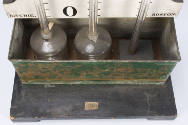

pressure gauge
Date1870-1890
Inventory Number1996-1-0400
ClassificationPressure Gauge
Subject
Maker
E. S. Ritchie & Sons
founded 1867
Cultural Region
Place of Origin
Place of Use
Dimensions93 x 31 x 46 cm (36 5/8 x 12 3/16 x 18 1/8 in.)
storage: 111.6 x 37.2 x 55.2 cm (43 15/16 x 14 5/8 x 21 3/4 in.)
storage: 111.6 x 37.2 x 55.2 cm (43 15/16 x 14 5/8 x 21 3/4 in.)
Material
Accessoriesfour wooden knobs or stoppers
DescriptionThree glass tubes placed vertically next to each other in front of a wooden backing with a scale from 0 to 30 (inches; marked up to 25). The bottom of the tubes goes inside a green metal trough. At the bottom inside the trough, one of the tubes is simply supported by a square wooden base, while the other two lead into identical glass flasks.
The trough and backing rest on a black wooden case.
The trough and backing rest on a black wooden case.
Signedon backing: RITCHIE, BOSTON
on trough: E.S. RITCHIE / BOSTON
Inscribedold label on base: COLLEGE / PROPERTY
FunctionThis looks like a triple pressure gauge. The metal trough would be filled with mercury, and when the upper ends of the tubes are exposed to the air, the mercury level in them would be zero. If one however connects the upper ends to a system in a more rarefied atmosphere, the mercury level will rise in them, giving a reading in vacuum inches (pressure units with the zero at standard atmosphere). The presence of three tubes would allow the comparison of the pressure of different systems.
The function of the wooden knobs is uncertain. Perhaps they are stoppers for the vertical tubes.
The function of the wooden knobs is uncertain. Perhaps they are stoppers for the vertical tubes.
ProvenanceFollowing the label, probably Harvard University.


Todd Scientific Company
Date: 1955-1965
Object number: 1996-1-0396

Andrew Pritchard
Date: 1835-1840
Accessories: objectives (4); oculars (6); lieberkühns (4); stage forceps; bull's eye condenser on stand; spring stage; extra mechanical stage; polarizer; cup diaphragms and holders; substage fork mount; live box; glass troughs (2); concave glass; fish tube holder; case; 2 keys. See also slide micrometers (2) (1088b,c)
Object number: 1088a

W. Watson & Sons Ltd.
Date: circa 1885
Accessories: oculars (2 pairs): B and D; objectives in marked canisters (4): 1/4, 1/2, 1, 3 inches; condenser with iris diaphragm; rotating wheel diaphragm; iris diaphragm; set of 4 disk diaphragms in brass box; triple nosepiece; live box; prisms for Wenham binocular system (2); stage for simple microscope with rotating wheel diaphragm; vulcanite stage; spare knobs (2); parts box; case
Object number: 1249


E. S. Ritchie & Sons
Date: 1868-1895
Accessories: a) two wheels made of an insulating material (ebonite?), solid except for an oval perforation near the edge, and a depression running on one face along its diameter; b) a spark-gap consisting of two brass balls that hold small rods that face each other, their distance adjustable by screws on the balls. The brass balls are mounted on parallel rods (adjustable height) attached to a thick brass rod that can be held from a thinner rod attached to its central section; c) two large screws and a wooden piece in the shape of a quarter-section of a cylinder, which are currently held inside a plastic bag
Object number: 2007-1-0171