


glass electrode pH meter
Date1958
Inventory Number1996-1-0277
ClassificationpH Meter
Subject
Maker
Beckman Instruments, Inc.
1950 - 1997
Cultural Region
Place of Origin
Dimensions27.3 × 28.5 × 22.5 cm (10 3/4 × 11 1/4 × 8 7/8 in.)
Material
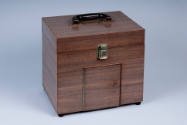
DescriptionWooden case, rectangular prism shape, horizontal orientation, leather strap handle on top. Lid of case at top, connected along side of box with detachable hinge, metal clasp in front. Lid lifts up to reveal a black panel, screwed horizontally across the top of the box. On top of this panel are dials, switches and meters. Adhered to the inside of the lid is a printed page with text and illustrations bearing the title "INSTRUCTIONS FOR THE/BECKMAN MODEL G pH METER". On the front of the box is a small hinged door with a metal knob handle. Behind the door is a recessed space, lined with white enameled metal. Attached to the inside of this door is a retort style clamp with arms extending into a small glass beaker. The beaker is topped with black bakelite fittings from which extend two black wires which attach to the back of the recess.
Signedon instrument: BECKMAN INSTRUMENTS, INC. FULLERTON, CALIF.
Inscribedon instrument: BECKMAN Model GS / Serial 224109 GLASS ELECTRODE pH METER BECKMAN INSTRUMENTS, INC. FULLERTON, CALIF. / MADE IN U. S. A.
Curatorial RemarksSeveral valuable short histories of Arnold O. Beckman and the invention of the pH meter are available online <a href="http://portal.acs.org/portal/acs/corg/content?_nfpb=true&_pageLabel=PP_ARTICLEMAIN&node_id=929&content_id=CTP_004464&use_sec=true&sec_url_var=region1" target="_blank">1</a>, <a href="http://www.chemheritage.org/classroom/chemach/electrochem/beckman.html" target="_blank">2</a>, <a href="http://chem.ch.huji.ac.il/instruments/electrochemical/ph_meter_beckman_g.html" target="_blank">3</a>, <a href="http://www.wooster.edu/chemistry/is/brubaker/ph/ph_works_g.html" target="_blank">4</a>.
FunctionThe Beckman Model G pH Meter was the first commercially successful pH meter largely because of its compact and self-contained system of glass electrodes that allowed chemists to easily and quickly determine the power of hydrogen ions, or pH, of almost any solution.
A glass electrode consists of a glass membrane that is placed in a sample. Inside the electrode is a buffer of known pH. Depending on the pH of the sample solution, hydrogen ions will naturally migrate across the glass membrane to the area of lower concentration (in this case, the solution with higher pH). As protons migrate across the membrane, a voltage builds up that can be measured. Because glass has a high electrical resistance, very little current is generated to be measured.
To overcome the difficulty of measuring a very small current, Arnold Beckman recommended a dual-stage amplification system to multiply the current from the glass electrode. Beckman's amplification system used two vacuum tube amplifiers in series; the minuscule current is multiplied by the first tube, then that amplified current is multiplied by the second, increasing the size of the current enough for it to be detected by an ordinary current meter, or galvanometer.
To collect data on a Model G, the operator had to rotate a "pH dial" while watching the galvanometer, or null balance meter. The pH dial altered a current designed to balance the voltage of the current from the electrode while the null balance meter displayed how much current was flowing through the system. When the "null balance meter" on the Model G read zero and was stable, that indicated that the current from the sample exactly canceled out current from the Model G. The current from the Model G was controlled by the pH dial, so when the null-balance meter stopped at zero the pH of the sample was displayed by the reading on the pH dial.
The model GS pH meter provided higher measuring accuracy through increased sensitivity of the detecting system. The model GS reads directly in pH, as does the model G, for normal measurements, but when the model GS is used for expended scale measurements, the reading is in millivolts. For the latter measurements the sensitivity is increased by a factor of approximately 20.
A glass electrode consists of a glass membrane that is placed in a sample. Inside the electrode is a buffer of known pH. Depending on the pH of the sample solution, hydrogen ions will naturally migrate across the glass membrane to the area of lower concentration (in this case, the solution with higher pH). As protons migrate across the membrane, a voltage builds up that can be measured. Because glass has a high electrical resistance, very little current is generated to be measured.
To overcome the difficulty of measuring a very small current, Arnold Beckman recommended a dual-stage amplification system to multiply the current from the glass electrode. Beckman's amplification system used two vacuum tube amplifiers in series; the minuscule current is multiplied by the first tube, then that amplified current is multiplied by the second, increasing the size of the current enough for it to be detected by an ordinary current meter, or galvanometer.
To collect data on a Model G, the operator had to rotate a "pH dial" while watching the galvanometer, or null balance meter. The pH dial altered a current designed to balance the voltage of the current from the electrode while the null balance meter displayed how much current was flowing through the system. When the "null balance meter" on the Model G read zero and was stable, that indicated that the current from the sample exactly canceled out current from the Model G. The current from the Model G was controlled by the pH dial, so when the null-balance meter stopped at zero the pH of the sample was displayed by the reading on the pH dial.
The model GS pH meter provided higher measuring accuracy through increased sensitivity of the detecting system. The model GS reads directly in pH, as does the model G, for normal measurements, but when the model GS is used for expended scale measurements, the reading is in millivolts. For the latter measurements the sensitivity is increased by a factor of approximately 20.
ProvenanceFrom Bert Vallee, Peter Bent Hospital, Biophysics Laboratory.


National Technical Laboratories
Date: 1938-1945
Accessories: key on a string
Object number: 1997-1-1122
Beckman Instruments, Inc.
Date: circa 1955
Accessories: instructions attached to underside of box lid
Object number: 1996-1-0276


Richard W. Thomas
Date: circa 1861
Accessories: bottle and beaker (1998-1-1634a); hydrometer and manual (1998-1-1634b)
Object number: 1998-1-1634


Heath Company
Date: circa 1967
Accessories: 120ft roll of paper (1996-1-0460b); box
Object number: 1996-1-0460a


Beckman Instruments, Inc.
Date: after 1940
Accessories: clear rings (3); black cylindrical tube; long black rectangular object; short black rectangular object; metal rings (4); glass slides (3); CENCO FILTER / NO. 87308-A and CENCO FILTER / NO. 87308-?10B from CENTRAL SCIENTIFIC CO.; manual on file
Object number: 1998-1-1003a
Gled Radio Company
Date: 1924
Object number: 1997-1-0076