


pH electrometer
Date1938-1943
Inventory Number1997-1-0384
ClassificationpH Meter
Subject
Maker
Coleman Electric Company, Inc
fl. 1937
Repaired by
Alvin S. Mancib Company
fl. 1930 - 1970
User
Chemistry Laboratory, Harvard College
founded 1850
Cultural Region
Place of Origin
Dimensions27.5 × 30 × 19.8 cm (10 13/16 × 11 13/16 × 7 13/16 in.)
Material
DescriptionWooden case, rectangular prism shape, horizontal orientation. Lid of case at top, connected along side of box with detachable hinge, metal clasp in front. Adhered to the inside of the lid is a printed page with text and illustrations bearing the title "Directions For Model 3 pH Meter: Technical Applications of Electrical Methods"; subtitles include 'OPERATION', 'TESTING UNKNOWN SOLUTIONS', and 'BATTERIES'. On the outside of the front of the box is a rectangular sticker (the corners are decoratively missing, so the sticker is actually octagonal) with a red border that reads 'E 3198 / PDR - RBW'; the sticker was likely placed there by the user.
Lid lifts up to reveal a black panel, screwed horizontally across the top of the box. On top of this panel are different kinds of black plastic dials (with labels such as 'AP' and 'SC'), and meters (one of which is labeled 'pH ELECTROMETER'). At the front and middle of the black panel is the signature plate with information such as the model number. A slit between the left side of the box and the left side of the black panel is presumably where the sample being tested is meant to be kept. Two components are in this space: a glass tube with a black and white probe that runs through its orange stopper; a black cylinder mounted to the side of the box by a piece of black plastic and a tightening screw.
Chemical Laboratory number: no. E3198
Lid lifts up to reveal a black panel, screwed horizontally across the top of the box. On top of this panel are different kinds of black plastic dials (with labels such as 'AP' and 'SC'), and meters (one of which is labeled 'pH ELECTROMETER'). At the front and middle of the black panel is the signature plate with information such as the model number. A slit between the left side of the box and the left side of the black panel is presumably where the sample being tested is meant to be kept. Two components are in this space: a glass tube with a black and white probe that runs through its orange stopper; a black cylinder mounted to the side of the box by a piece of black plastic and a tightening screw.
Chemical Laboratory number: no. E3198
Signedon small plaque, on black panel: COLEMAN ELECTRIC CO., INC. / MAYWOOD, ILL.
Inscribedon black panel, in center: pH ELECTROMETER
at top of instruction page, affixed to inside of lid: Directions For Model 3 pH Meter: Technical Applications of Electrical Methods
Curatorial RemarksRepair tag from Alvin S. Mancib Co., 26 Wallace Street, West Somerville, Mass., repair #75205.
FunctionThis apparatus performs functions similar to those of the Beckman Model G pH Meter (see, for example, 1997-1-0658). Both instruments are compact and self-contained systems of glass electrodes that allowed chemists to easily and quickly determine the power of hydrogen ions, or pH, of almost any solution.
A glass electrode consists of a glass membrane that is placed in a sample. Inside the electrode is a buffer of known pH. Depending on the pH of the sample solution, hydrogen ions will naturally migrate across the glass membrane to the area of lower concentration (in this case, the solution with higher pH). As protons migrate across the membrane, a voltage builds up that can be measured. Because glass has a high electrical resistance, very little current is generated to be measured.
To overcome the difficulty of measuring a very small current, this apparatus uses "the well-known Coleman impulse amplifier circuit" to multiply the current from the glass electrode. The amplified current is increased just enough to be detected by an ordinary current meter, or galvanometer.
To collect data on this apparatus, the operator had to rotate the main dial while watching the galvanometer, or null balance meter. The main dial altered a current designed to balance the voltage of the current from the electrode while the null balance meter displayed how much current was flowing through the system. When the "null balance meter" read zero and was stable, that indicated that the current from the sample exactly canceled out the current controlled by the pH dial. Thus, when the null-balance meter stopped at zero the pH of the sample was displayed by the reading on the pH electrometer.
A glass electrode consists of a glass membrane that is placed in a sample. Inside the electrode is a buffer of known pH. Depending on the pH of the sample solution, hydrogen ions will naturally migrate across the glass membrane to the area of lower concentration (in this case, the solution with higher pH). As protons migrate across the membrane, a voltage builds up that can be measured. Because glass has a high electrical resistance, very little current is generated to be measured.
To overcome the difficulty of measuring a very small current, this apparatus uses "the well-known Coleman impulse amplifier circuit" to multiply the current from the glass electrode. The amplified current is increased just enough to be detected by an ordinary current meter, or galvanometer.
To collect data on this apparatus, the operator had to rotate the main dial while watching the galvanometer, or null balance meter. The main dial altered a current designed to balance the voltage of the current from the electrode while the null balance meter displayed how much current was flowing through the system. When the "null balance meter" read zero and was stable, that indicated that the current from the sample exactly canceled out the current controlled by the pH dial. Thus, when the null-balance meter stopped at zero the pH of the sample was displayed by the reading on the pH electrometer.
ProvenanceFrom the Department of Chemistry, Harvard University.

National Technical Laboratories
Date: 1938-1945
Accessories: key on a string
Object number: 1997-1-1122


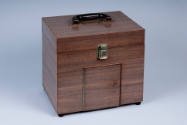
Beckman Instruments, Inc.
Date: circa 1955
Accessories: instructions attached to underside of box lid
Object number: 1996-1-0276


Heath Company
Date: circa 1967
Accessories: 120ft roll of paper (1996-1-0460b); box
Object number: 1996-1-0460a
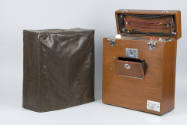
Sanborn Company
Date: 1930-1945
Accessories: leather cover; cloth cover; thin red wire
Object number: 1996-1-0278

Richard W. Thomas
Date: circa 1861
Accessories: bottle and beaker (1998-1-1634a); hydrometer and manual (1998-1-1634b)
Object number: 1998-1-1634

Hickok Electrical Instrument Company
Date: 1955-1965
Object number: 1998-1-0879

Western Electric Company
Date: before 1933
Accessories: cords missing
Object number: RS0153
Apple Computer Inc.
Date: 1987-1990
Accessories: AppleDesign keyboard; Logitech mouse (not original); connection cables (b)
Object number: 2009-1-0018a