


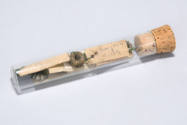
two manganin (?) coils
Date1932
Inventory Number2010-1-0008
Classification(not assigned)
Subject
Maker
Percy Williams Bridgman
1882 - 1961
Cultural Region
Place of Origin
Place of Use
Dimensions18.2 x 2.2 x 2.2 cm (7 3/16 x 7/8 x 7/8 in.)
Material
DescriptionTwo small tightly wound coils of metal wire (possibly manganin), each held together with white string. One of the coils has a red wire coil (possibly copper) wound around the circumference, with excess loose in the tube. Both coils are stored in a glass test tube closed with a cork that has a metal loop attached to the top.
Signedunsigned
Inscribedhandwritten in black on white piece of paper folded inside the tube: Manganis [manganin?] coils, wound June 7, 1932. / Original length before reaching splice / Short (or shunt or?) coil in last before splice
FunctionHigh pressure physics.
Samples likely used in experiments with high pressure apparatuses.
Samples likely used in experiments with high pressure apparatuses.
ProvenanceGift of Professor Gerald Holton, Physic Department, Harvard University. Created/used by Professor Percy Bridgman, Department of Physics, Harvard University.
Historical AttributesPercy Bridgman's experimental work at Harvard University consisted mainly in the production of very high pressures and the investigation of the effects such pressures have on the properties of matter.
During the 1920s, most of Bridgman's experiments used high pressures between 12 000 and 20 000 atmospheres (12,000-20,000 kg/cm²). In order to produce such high pressures, Bridgman used a hydraulic press in conjunction with two pumps in order to produce the high pressures. See for example, 1997-1-1819a, b, c and d.
During the 1930s, Bridgman increased the pressure, reaching between 30 000 and 50 000 atmospheres using two and even three hand pumps.
Bridgman would put samples of various materials into a chamber of the press, raise the pressure inside the chamber, and then study the material samples or residues that remained afterward. He the effects of high pressures on the <i>specific resistance, temperature coefficients, volume, electrical conductivity, shearing strength, electrical resistance, density, tensile properties,</i> and <i>compression</i>. He studied these effects on all manner of substances from minerals, metals, and chemicals to plastics, glass and egg yolks. Bridgman hoped his experimental results would contribute to theories of the internal structure of atoms and molecules that were gaining attention throughout the first half of the 20th century. He was awarded the Nobel Prize for Physics in 1946 for his research.
Bridgman also did work on the synthesis of diamonds from graphite using very high pressures and temperatures. Early in 1941, the General Electric Company arranged a five year agreement with Bridgman to finance his experimental research in producing diamonds. Bridgman wanted to reverse a known process in which diamonds turn to graphite at atmospheric pressure and 1500°C. His experiments were conducted in the Harvard Geophysical Laboratory. However, Bridgman was ultimately unsuccessful in the synthesis of diamonds, and his continued research was interrupted by the outbreak of the Second World War.
Percy Williams Bridgman
Date: 1919-1929
Accessories: wooden test tube holder
Object number: 1998-1-0060o

Percy Williams Bridgman
Date: 1928-1957
Accessories: two small rectangular cardboard boxes
three small round cardboard boxes
one large round cardboard box
Object number: 1999-1-0045b

Date: 1890-1930
Object number: RS0508

French
Date: circa 1880
Accessories: protecting case with glass window
Object number: DW0095

Percy Williams Bridgman
Date: 1919
Accessories: wooden test tube holder
Object number: 1998-1-0060j

Percy Williams Bridgman
Date: dated 1939
Accessories: wooden test tube holder
Object number: 1998-1-0060h

Date: late 19th-early 20th Century
Object number: RS0168

Percy Williams Bridgman
Date: dated 1916
Accessories: wooden test tube holder
Object number: 1998-1-0060l


American
Date: circa 1930
Object number: 1998-1-0639

Percy Williams Bridgman
Date: dated 1917
Accessories: wooden test tube holder
Object number: 1998-1-0060p
