


perimeter
Datecirca 1893
Inventory NumberWJ0034
ClassificationPerimeter
Subject
Maker
Meyrowitz Brothers
1875-present
User
Hugo Münsterberg
1863 - 1916
Cultural Region
Place of Origin
Dimensionsmax height: 60 × 20 × 41 cm (23 5/8 × 7 7/8 × 16 1/8 in.)
Material
DescriptionThe cast-iron structure is made of two feet and a long curved third one. At the end of the latter, a vertical rod has been fixed, holding a support piece used for the patient's chin. The large half-circle sighting screen is blank on the patient's side, and graduated on the other side (the graduated lines are red on one side, and white on the other). A chart would have been added on the patient's side. A slider (one is perhaps missing here) on small wheels can move along its edges. It has a small colored dot on it. When it moves left and right, it measures the periphery vision of the patient. This screen can be rotated 90 degrees, to do the same examination for the up and down peripheral vision. A large wheel at the back is equipped with a paper clip and a small colored scale.
Signedon feet, embossed: E. B. MEYROWITZ, N. Y.
FunctionStudying visual sensations, especially peripheral vision.
A description of a similar instrument made by C. H. Stoelting of Chicago is found in their 1937 trade catalogue, found online here.
A description of a similar instrument made by C. H. Stoelting of Chicago is found in their 1937 trade catalogue, found online here.
ProvenancePsychology Department, William James Hall, Harvard University.
Historical AttributesThis instrument is found in Hugo Münsterberg's 1893 <i>Psychological Laboratory of Harvard University</i> document. It is thus listed: "89. Two perimeters. After Landholt and Priestley Smith, by Meyrowitz, New York. $50."
See online reproduction <a href="http://psychclassics.yorku.ca/Munster/Lab/" target="_blank">here</a>.


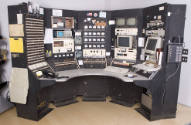
Harvard Cyclotron Laboratory
Date: 1947-2002
Object number: 2003-1-0291


George Cruikshank
Date: dated 1817
Accessories: slip of paper containing brief commentary
Object number: 1998-1-1095


