

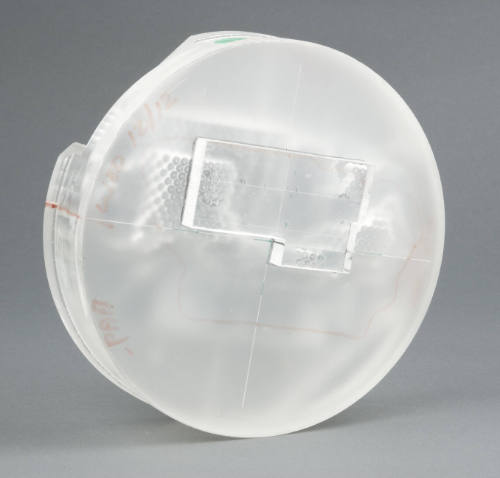


proton beam range compensator
Date2001
Inventory Number2002-1-0030b
ClassificationRange Compensator
Subject
Maker
Elliot Hammerman
Place of Origin
Dimensions20.1 x 20.1 x 7.2 cm (7 15/16 x 7 15/16 x 2 13/16 in.)
Material
DescriptionThe plastic range compensator is drilled out in places in order to alter the extant of depth that the proton beam would penetrate the patient's tumor.
Metal rods are positioned in the face of the range compensator in order to mate it with the brass aperture (2002-1-0030a).
In red ink, "PAA / WED 12/12" is written on the top face and "PAA / WED 12-12" is written on the side. In green ink, "JMC 12/31/1" is written on the top face. A green circular sticker is scotch-taped to the side with the label "12/21/01 / AP."
Metal rods are positioned in the face of the range compensator in order to mate it with the brass aperture (2002-1-0030a).
In red ink, "PAA / WED 12/12" is written on the top face and "PAA / WED 12-12" is written on the side. In green ink, "JMC 12/31/1" is written on the top face. A green circular sticker is scotch-taped to the side with the label "12/21/01 / AP."
In Collection(s)
Signedunsigned
FunctionThe range compensator (or bolus) was designed to shape the depth to which the proton beam from the cyclotron would penetrate a patient's tumor.
Historical AttributesThis range compensator was used to treat a tumor in a patient at the Harvard Cyclotron Laboratory in 2001.


Harvard Cyclotron Laboratory
Date: 1947-2002
Object number: 2003-1-0291

Harvard Cyclotron Laboratory
Date: 1980-1984
Object number: 2003-1-0275

Western Electric Company
Date: 1900-1930
Object number: RS0196


See also/See also
