

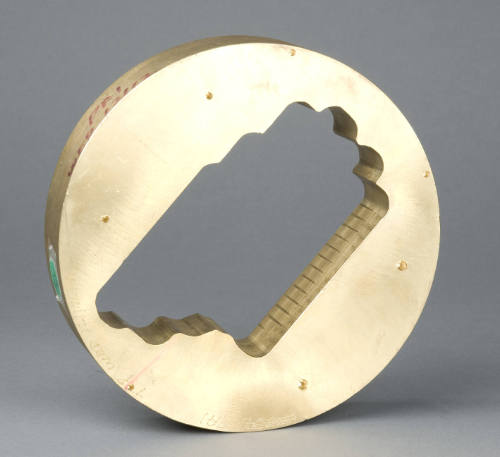


proton beam aperture
Date2001
Inventory Number2002-1-0030a
ClassificationAperture
Subject
Maker
Elliot Hammerman
Cultural Region
Place of Use
Dimensions27.9 lb. (12.7 kg)
Overall - Storage: 19 x 19 x 4.4 cm (7 1/2 x 7 1/2 x 1 3/4 in.)
the instrument: 19 x 19 x 19 x 4.4 cm (7 1/2 x 7 1/2 x 7 1/2 x 1 3/4 in.)
Overall - Storage: 19 x 19 x 4.4 cm (7 1/2 x 7 1/2 x 1 3/4 in.)
the instrument: 19 x 19 x 19 x 4.4 cm (7 1/2 x 7 1/2 x 7 1/2 x 1 3/4 in.)
Material
DescriptionThe brass aperture has an irregular hole drilled through the center. Holes are drilled on the faces in order to mate the aperture with the range compensator (2002-1-0030b).
Along the side, it is marked in purple ink, "PA1/ WED 12/12" (twice). A green circular sticker is scotch-taped to the side with the label, "Alt / 10/21/01." There is also a cross.
On the front face, there is an obliterated inscription and the engraved markings, "PA1 T[hole]P WED 12 FA." PA1 stands for Posterior Anterior One.
Along the side, it is marked in purple ink, "PA1/ WED 12/12" (twice). A green circular sticker is scotch-taped to the side with the label, "Alt / 10/21/01." There is also a cross.
On the front face, there is an obliterated inscription and the engraved markings, "PA1 T[hole]P WED 12 FA." PA1 stands for Posterior Anterior One.
In Collection(s)
Signedunsigned
FunctionA brass aperture was used to shape the transverse cross-section of the proton beam used to treat a tumor or other tissue in a medical patient.
Historical AttributesThis aperture was used to treat a tumor in a patient at the Harvard Cyclotron Laboratory in 2001.


Weston Electrical Instrument Corporation
Date: circa 1890
Object number: 1997-1-1061


W. & S. Jones
Date: circa 1799
Accessories: original curatorial cards (in instrument file); typed draft of curatorial card on white paper from January 1967 (in instrument file); two black and white photos (in instrument file)
Object number: 0066a
See also/See also
