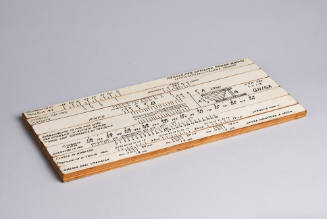
Barth's feed-speed slide rule
Datedated 1904
Inventory Number1990-4-0099
ClassificationSlide Rule
Subject
Maker
Carl G. Barth
1860-1939
Associate Name
Frederick W. Taylor
1856-1915
Cultural Region
Place of Origin
Dimensions2.4 × 22.9 × 12.8 cm (15/16 × 9 × 5 1/16 in.)
Material
DescriptionRectangular rule with seven slides, faced with off-white paper and raised on two wooden legs. The top, fourth, and bottom slides are fixed; the second, third, fifth, and sixth slides move to left and right.
Printed toward the left edge of the top slide and facing the second slide is an arrow bisecting a single circle.
On the left-hand side of the second, moveable slide is a grid for "BELT DATA. / VELOCITY IN THOUSAND FEET / AND CROSS-SECTION IN SQ. INS." The grid's off-vertical lines are labeled with values ranging from 0.2 to 2.5; its horizontal lines are labeled with values 1, 2, 3, and 4.
The bottom edge of the right-hand side of the same (second) slide is printed with a scale for "DEPTH OF CUT," with values ranging from 1/16'' to 1''.
The top edge of the third, moveable slide is printed with a scale for "DIAMETER OF WORK," with values descending from 60'' to 2''. Near the bottom edge of the same slide is a scale for "CONE DIAM. X GEAR REDUCTION," with values descending from 3000'' to 3''.
Near the top and bottom edges of the fourth slide is a scale for "FEED," with values descending from 0.4 to 0.0005.
Printed near the top edge of the fifth, moveable slide is a scale for "REV. OF SPINDLE," carrying values from 2 to 200. The bottom edge of the same slide is printed with a scale for "DIAMETER OF WORK," with values descending from 60'' to 2''.
Along the top edge of the sixth, moveable slide is a scale for "CLASS NO.," with values (in whole numbers) ranging from 0 to 30. The bottom edge of the same slide is printed with three scales for "DEPTH OF CUT." The left-most scale, labeled for a "1 1/4'' TOOL," has values descending from 1'' to 3/32''. The center scale, labeled for a "3/4'' TOOL," has values descending from 3/4'' to 3/32''. The right-most scale, labeled for a "1/2'' TOOL," has values descending from 1/2'' to 3/32''.
Printed along the top edge of the bottom slide are three identical scales for "LIFE OF TOOL," each with values ranging from 10MIN. to 2HRS.
Printed toward the left edge of the top slide and facing the second slide is an arrow bisecting a single circle.
On the left-hand side of the second, moveable slide is a grid for "BELT DATA. / VELOCITY IN THOUSAND FEET / AND CROSS-SECTION IN SQ. INS." The grid's off-vertical lines are labeled with values ranging from 0.2 to 2.5; its horizontal lines are labeled with values 1, 2, 3, and 4.
The bottom edge of the right-hand side of the same (second) slide is printed with a scale for "DEPTH OF CUT," with values ranging from 1/16'' to 1''.
The top edge of the third, moveable slide is printed with a scale for "DIAMETER OF WORK," with values descending from 60'' to 2''. Near the bottom edge of the same slide is a scale for "CONE DIAM. X GEAR REDUCTION," with values descending from 3000'' to 3''.
Near the top and bottom edges of the fourth slide is a scale for "FEED," with values descending from 0.4 to 0.0005.
Printed near the top edge of the fifth, moveable slide is a scale for "REV. OF SPINDLE," carrying values from 2 to 200. The bottom edge of the same slide is printed with a scale for "DIAMETER OF WORK," with values descending from 60'' to 2''.
Along the top edge of the sixth, moveable slide is a scale for "CLASS NO.," with values (in whole numbers) ranging from 0 to 30. The bottom edge of the same slide is printed with three scales for "DEPTH OF CUT." The left-most scale, labeled for a "1 1/4'' TOOL," has values descending from 1'' to 3/32''. The center scale, labeled for a "3/4'' TOOL," has values descending from 3/4'' to 3/32''. The right-most scale, labeled for a "1/2'' TOOL," has values descending from 1/2'' to 3/32''.
Printed along the top edge of the bottom slide are three identical scales for "LIFE OF TOOL," each with values ranging from 10MIN. to 2HRS.
Signedface, third slide on right: STEEL / Carl G. Barth
Inscribedface, top slide on right: PATENTED MARCH 8TH, 1904.;
back, center: CARL G. BARTH & SON, / CONSULTING ENGINEERS / TAYLOR SYSTEM OF SCIENTIFIC MANAGEMENT / 6151 COLUMBIA AVENUE, PHILADELPHIA
Curatorial RemarksIdentical in function to 1990-3-0003, though the latter is for making calculations when cutting cast iron, while this instrument is making calculations when cutting steel. In addition, this instrument has an arrow instead of a "CLASS NO." scale on the top slide, is of different dimensions, and is raised on wooden legs.;
Similar in function to Italian-language feed-speed rule, see 1990-4-0002.
FunctionFor calculating the most efficient feed-speed setting combination when cutting steel on a lathe or similar machine.
The user first moves the second slide to left or right until the arrow on the top slide points to the point on the grid (second slide) representing the appropriate belt cross-section and velocity . Holding the second slide in place, he then moves the third slide to left or right such that the appropriate value on the diameter of work scale (third slide) coincides with the appropriate value on the depth scale (second slide).
Holding the second and third slides in place, the user then moves the sixth slide to left or right until the appropriate value on the depth scale matching his tool size (sixth slide) aligns with the length of time he needs to use the tool on the adjacent life of tool scale (bottom slide). Finally, holding the second, third, and sixth slides in place, the user moves the fifth slide to left or right such that the appropriate value on the diameter of work scale (fifth slide) coincides with the appropriate value on the class number scale (sixth slide).
The final positions of the slides indicate the available feed-speed combinations. Only those values for spindle revolutions and cone diameter (adjusted, as needed, according to whether or not back gears are in use) that fall within the feed scale will maximize efficiency. Thus, the user should, in choosing among the feed and speed settings available on his particular machine, select that combination whose values on the rule come closest to coinciding.
The user first moves the second slide to left or right until the arrow on the top slide points to the point on the grid (second slide) representing the appropriate belt cross-section and velocity . Holding the second slide in place, he then moves the third slide to left or right such that the appropriate value on the diameter of work scale (third slide) coincides with the appropriate value on the depth scale (second slide).
Holding the second and third slides in place, the user then moves the sixth slide to left or right until the appropriate value on the depth scale matching his tool size (sixth slide) aligns with the length of time he needs to use the tool on the adjacent life of tool scale (bottom slide). Finally, holding the second, third, and sixth slides in place, the user moves the fifth slide to left or right such that the appropriate value on the diameter of work scale (fifth slide) coincides with the appropriate value on the class number scale (sixth slide).
The final positions of the slides indicate the available feed-speed combinations. Only those values for spindle revolutions and cone diameter (adjusted, as needed, according to whether or not back gears are in use) that fall within the feed scale will maximize efficiency. Thus, the user should, in choosing among the feed and speed settings available on his particular machine, select that combination whose values on the rule come closest to coinciding.
ProvenanceThe papers and slide rules of Carl G. Barth and his son, J. Christian Barth, were transferred to the Baker Library of the Harvard Business School by J. Christian Barth in 1961.
The slide rules were transferred from Harvard Business School to the Collection of Historical Instruments in 1980.
Historical AttributesThis is part of a set of slide rules for machine shops designed by Carl G. Barth under Frederick Winslow Taylor's system of scientific management. Given the characteristics of a particular machine and a depth of cut, for example, a shop manager could quickly calculate the most efficient speed and feed settings using one of Barth's speed and feed slide rules. Other objects in the collection include slide rules for helical springs, belts, and gears, as well as jigs for making slide rules.



Pickett & Eckel, Inc.
Date: copyright 1959
Accessories: brown leather case with hard plastic lining and flap closure; small plastic bag; Twin Pack box; 3 instruction manuals (in file); belt loop (1991-4-0004b); pocket slide rule (1991-4-0004c); cardboard box
Object number: 1991-4-0004a