


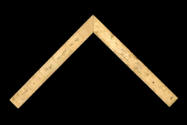
brass draftsman's rule
Datecirca 1850
Inventory NumberDW0459
ClassificationRule
Subject
Maker
Troughton & Simms
1826 - 1923
Cultural Region
Place of Origin
Dimensions0.2 x 31.7 x 2.7 cm (1/16 x 12 1/2 x 1 1/16 in.)
Material
DescriptionRule is a flat rectangular brass plate with one darker brass edge. Various scales are engraved in black on the front side of the rule. The darker edge is divided into thirty-six equally spaced increments by engraved lines. Two sets of number scales accompany the lines on the darker edge. The outermost scale increases from 0 to 36. Each of these increments is further subdivided in ten by smaller engraved lines, every fifth of which is longer. The numbers of the innermost scale are slightly smaller. They begin with 36 and decrease from left to right until 0.
The lighter part of the rule is also divided into 36 equal increments by engraved lines. They are also marked from 1 to 36, increasing from left to right. The numbers are one-off of the outermost scale of the dark edge such that 1 is below 2, 2 is below 3, and so forth. Each increment is further subdivided into ten rows by horizontal engraved lines that run the length of the rule. Every second of these lines is marked 2, 4, 6, and 8 at the leftmost end of the rule. The leftmost increment of this scale is divided by ten transversal lines that angle towards the bottom rightmost corner. The scale on the lighter component of the rule is called "Gunter's Vernier".
The lighter part of the rule is also divided into 36 equal increments by engraved lines. They are also marked from 1 to 36, increasing from left to right. The numbers are one-off of the outermost scale of the dark edge such that 1 is below 2, 2 is below 3, and so forth. Each increment is further subdivided into ten rows by horizontal engraved lines that run the length of the rule. Every second of these lines is marked 2, 4, 6, and 8 at the leftmost end of the rule. The leftmost increment of this scale is divided by ten transversal lines that angle towards the bottom rightmost corner. The scale on the lighter component of the rule is called "Gunter's Vernier".
Signedengraved on the back in black script: Troughton & Simms, London.
FunctionRule can be used as a straight edge for drawing or measuring straight lines. The transversal lines at the leftmost end are for increased precision. David P. Wheatland noted that "this is the type of reduced scale that architects use but usually 1/4 "to the feet"."
ProvenanceDavid P. Wheatland purchased from Avis & Rockwell Gardiner, Stamford, Connecticut, at the Ellis Memorial Antiques Show, October 30, 1972.



Gebrüder Haff
Date: circa 1960
Accessories: black storage case
two white cards with conversion tables inside case
Object number: 1997-1-2000

G. Coradi
Date: circa 1911
Accessories: conversion table on white card in instrument case; instrument case
Object number: 1999-1-0068

Walter Balcke
Date: 1953
Accessories: mahogany box; cardboard instruction card;
in library folder (Lib 4927):
-twenty-one letters from Joseph L. Walsh, mathematics professor at Harvard University, to Walter Balcke, dated between 27 May 1957 and 24 January 1964 (letters thank Balcke for the many mathematical models he gifted to the Mathematics Department, praise his skill and ingenuity, many invite him to faculty and personal luncheons, and one letter provides an analytic solution to the "13-point problem" behind one of Balcke's models)
- one letter from J.L. Walsh directly related to this object, the "modified slide rule", dated February 11, 1953
-three letters from Garret Birkhoff (then Chairman of the Harvard Mathematics Department) dated 3 March 1954, 4 January 1955, and 10 January 1955, each expressing gratitude (and in one case, an official department thank you) for the many mathematical models he gifted to the mathematics department
-photocopy of original envelope in which correspondence between mathematics department and Walter Balcke was stored (original was destroyed on 13 July 1997)
-photocopy of instructional card for object 1997-1-1671
- seven instructional cards that accompany the following Balcke models: Pascal's Theorem, Brianchon's Concurrent Lines, Trisector, Twelve Point Ellipse, Rolling Parabola, unknown, Equation Solution with a 'Constant' Variable and Thread
- photograph of the display case containing Balcke's models in the Harvard Mathematics department
Object number: 1997-1-1609

Antonius Giamin
Date: early 20th Century
Object number: DW0590