


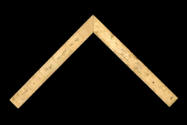
folding rule and square
Datecirca 1730
Inventory NumberDW0737
ClassificationRule-Folding
Subject
Maker
Jean-Baptiste-Nicolas Delure
fl. 1695 - 1736
Cultural Region
Place of Origin
Dimensions0.2 x 17.5 x 2 cm (1/16 x 6 7/8 x 13/16 in.)
Material
DescriptionThe rules are equally sized brass arms hinged together. One is for a half foot in the French royal system of pied du roi. The other is for Rhinish measurements. Each rule has a half-foot scale engraved along it. Each scale is divided into six increments, marked with engraved lines and numerals. The sixth increment on each rule is further subdivided in twelfths. That final increment is marked "lignes" on both rules. The rule marked "de my pied du Rhin" [half a Rhinish foot] has a second scale engraved along its other edge, divided into eleven equal increments. The first increment is further subdivided into ten increments, marked "5" half way and "10" at the end. Each subsequent increment is marked with an engraved numeral beginning with 10 and ending with 100, increasing in tens.
Signedengraved in script on instrument arm: Delure AParis
Inscribedengraved in script on instrument arm: De my pied de Roy
engraved in script on instrument arm: de my pied du Rhin
Curatorial RemarksSent by David P. Wheatland about 1985 to Christie's, New York for auction (Christie's tag DC830/215). Returned to the Collection of Historical Scientific Instruments in 1988 at William Andrewes' request.
FunctionThe rules are used to measure and draw straight lines. Each rule is equipped with a pre-revolutionary French imperial half-foot scale [pied de roi]. The two rules can be connected along the diagonal edges to form a fixed square for drawing and verifying right angles.
ProvenanceHarrold E. Gillingham, Philadelphia, Pennsylvania, purchased in Paris, 1923. David Wheatland purchased from Gillingham, 1949.


Gebrüder Haff
Date: circa 1940
Accessories: card with instrument info and conversion table; photocopy of letter from Dr. Joachim Fischer to William J.H. Andrewes, dated 12 May 1997; photocopy of extract from Dr. Joachim Fischer's inventory of integrating instruments included with the letter
Object number: 1997-1-0444

Gebrüder Haff
Date: circa 1940
Accessories: card with instrument information and conversion table
Object number: 1997-1-0445

Gebrüder Haff
Date: circa 1940
Accessories: case
Object number: 1997-1-0446

Jakob Amsler
Date: circa 1906
Accessories: instrument is in four (4) parts; the rail is in own box and is inventory # 2006-1-0002b; letter from Prof. William Brower containing the complete history of ownership and use (missing)
Object number: 2006-1-0002a

Walter Balcke
Date: 1953
Accessories: mahogany box; cardboard instruction card;
in library folder (Lib 4927):
-twenty-one letters from Joseph L. Walsh, mathematics professor at Harvard University, to Walter Balcke, dated between 27 May 1957 and 24 January 1964 (letters thank Balcke for the many mathematical models he gifted to the Mathematics Department, praise his skill and ingenuity, many invite him to faculty and personal luncheons, and one letter provides an analytic solution to the "13-point problem" behind one of Balcke's models)
- one letter from J.L. Walsh directly related to this object, the "modified slide rule", dated February 11, 1953
-three letters from Garret Birkhoff (then Chairman of the Harvard Mathematics Department) dated 3 March 1954, 4 January 1955, and 10 January 1955, each expressing gratitude (and in one case, an official department thank you) for the many mathematical models he gifted to the mathematics department
-photocopy of original envelope in which correspondence between mathematics department and Walter Balcke was stored (original was destroyed on 13 July 1997)
-photocopy of instructional card for object 1997-1-1671
- seven instructional cards that accompany the following Balcke models: Pascal's Theorem, Brianchon's Concurrent Lines, Trisector, Twelve Point Ellipse, Rolling Parabola, unknown, Equation Solution with a 'Constant' Variable and Thread
- photograph of the display case containing Balcke's models in the Harvard Mathematics department
Object number: 1997-1-1609