

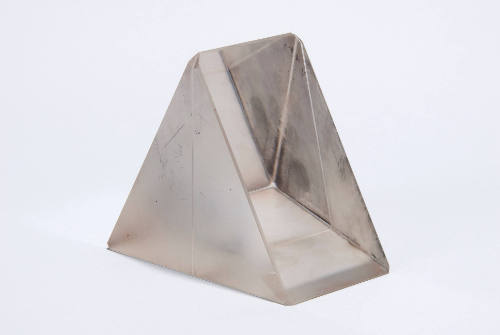


Cornu double quartz prism
Datecirca 1914
Inventory Number1998-1-1389
ClassificationPrism
Subject
Maker
American
User
Theodore Lyman IV
1874 - 1954
User
E. Bright Wilson, Jr.
1908 - 1992
Cultural Region
Dimensionsprism: 5.7 × 9.9 × 8.5 cm (2 1/4 × 3 7/8 × 3 3/8 in.)
box: 7 x 13.5 x 10.4 cm (2 3/4 x 5 5/16 x 4 1/8 in.)
box: 7 x 13.5 x 10.4 cm (2 3/4 x 5 5/16 x 4 1/8 in.)
Material
Accessoriesmounting plates and pads
DescriptionTwo 30° quartz prisms are cemented together to form an equiangular prism.
The base was painted black, but most of the paint is worn away. The word "Quartz" is written in script on the base. Another word may follow, but if so, it is illegible.
On the top surface, near a dimple where the two prisms are cemented together, there is this pencil annotation: "Note flaw July 17 /14."
The prism is accompanied by a two triangular pieces of sheet brass and two triangular pieces of cotton flannel, which would have sandwiched the Cornu prism in use. The cotton flannel has bits of human hair, as if the last user had just had a hair cut and was shedding.
The Cornu prism and its protective, brass end plates and cotton pads are stored in a cardboard box, which formerly held galvanized electrical connectors made by the Appleton Electric Company of Chicago.
The top of the box has Theodore Lyman's initials, and a paper label written by E. B. Wilson, Jr. who borrowed it from him.
The base was painted black, but most of the paint is worn away. The word "Quartz" is written in script on the base. Another word may follow, but if so, it is illegible.
On the top surface, near a dimple where the two prisms are cemented together, there is this pencil annotation: "Note flaw July 17 /14."
The prism is accompanied by a two triangular pieces of sheet brass and two triangular pieces of cotton flannel, which would have sandwiched the Cornu prism in use. The cotton flannel has bits of human hair, as if the last user had just had a hair cut and was shedding.
The Cornu prism and its protective, brass end plates and cotton pads are stored in a cardboard box, which formerly held galvanized electrical connectors made by the Appleton Electric Company of Chicago.
The top of the box has Theodore Lyman's initials, and a paper label written by E. B. Wilson, Jr. who borrowed it from him.
Signedunsigned prism
on box label: APPLETON ELECTRIC COMPANY / CHICAGO
Inscribedin pencil on prism base: Quartz
in pencil on prism top, with line to dimple near cemented edge: Note / flaw / July 17 /14
in brown ink on box lid: Cornu Prism / T. L.
in brown ink on paper label on box lid: Quartz Cornu Prism / about 10 cm side 6 cm / high. Belongs to Prof. T. / Lyman. (see my letter to / him 4/15/46. / E. B. Wilson Jr / 4/15/46.
FunctionA Cornu double prism is a compound prism formed by cementing two 30° prisms together. One prism is made of right-handed quartz, and the other of left-handed quartz. The resulting prism has no double refraction and good ultra-violet transmitting properties.
ProvenanceTheodore Lyman, Department of Physics, Harvard University, circa 1914; E. Bright Wilson, Jr., Department of Chemistry, Harvard University, circa 1946.
Historical AttributesThis Cornu prism was used first by Harvard physicist, Theodore Lyman and then by Harvard physical chemist, E. Bright Wilson, Jr., both pioneers and world leaders in spectroscopy.


American
Date: 1900-1930
Object number: 2007-1-0421
American
Date: 1900-1925
Accessories: none
Object number: 1998-1-1398b


Nachet et Fils (I)
Date: 1862
Accessories: 1 cup diaphragm, 1 diffuser; camera lucida; stage and eyepiece micrometers; liquid trough; 3 dissecting knives; prepared slides in box (1157d); 3 prepared slides loose; plain slides; cover glasses; bull's eye on jointed arm(1157e); Amici's illuminator prism with stand (1157f); compressorium (1157g); case with parts box (1157c).
Object number: 1157c


Jules Duboscq & Philibért François Pellin
Date: 1890-1910
Object number: BH0143


