


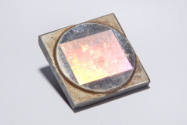
diffraction grating (reproduction) from Rowland original
Date1936
Inventory Number2054
ClassificationDiffraction Grating
Subject
Maker
Sir Thomas Ralph Merton
1888 - 1969
Cultural Region
Place of Origin
Dimensions8.3 × 11 × 0.3 cm (3 1/4 × 4 5/16 × 1/8 in.)
Material
DescriptionThis reproduction grating from a Rowland original made on speculum metal is made from a thin film sheet of cellulose ester solution that once dried, was squeezed in between two glass plates, which are taped together. This grating could be used in a lantern slide projector.
Signedunsigned
FunctionA diffraction grating is a glass or mirror that has regularly spaced microscopic interruptions to the passage of light (lines) such that light passing through or reflected by it experiences interference phenomena, magnifying its magnitude at some angles and cancelling it at others. As this effect depends on the wavelength of light, a diffraction grating is an effective method of decomposing light into its constituent wavelengths, that will be transmitted at different angles (short wavelengths -- bluer -- are deflected less than longer -- redder -- ones). If one knows the line density (lines per inch) and the angle of deflection (with a spectrometer), one can deduce the exact wavelengths.
Diffraction gratings like this one were often used in astronomy to produce spectra of celestial objects. Begun in 1882, Rowland's gratings were more than an order of magnitude larger and more accurate than any previous one. With these, for instance, it became possible to measure the wavelength of light emitted by atoms to unprecedented accuracy. Rowland himself was able to draw a new and more accurate map of the solar spectrum.
For more information go to the following website.
Diffraction gratings like this one were often used in astronomy to produce spectra of celestial objects. Begun in 1882, Rowland's gratings were more than an order of magnitude larger and more accurate than any previous one. With these, for instance, it became possible to measure the wavelength of light emitted by atoms to unprecedented accuracy. Rowland himself was able to draw a new and more accurate map of the solar spectrum.
For more information go to the following website.
ProvenanceFrom D. V. Thompson, class of 1922.
Historical AttributesAccording to the card: "[This grating] was reproduced by Merton of Winforton House of Hereford in 1936 (Sir Thomas Ralph Merton) by a new cellophane squeeze method invented by him and covered by British Patent. The original grating on speculum metal was made by Rowland at Johns-Hopkins & given to his successor "Prof." Robert W. Wood who presented it to Merton who made the squeeze from it and gave this sample to Mr. Thompson in 1936 when he visited Merton at Winforton House."


Central Scientific Company
Date: 1910-1930
Object number: 2059


Henry A. Rowland
Date: circa 1884
Accessories: wooden box; key
Object number: 2031

Central Scientific Company
Date: 1920-1930
Object number: 2057



Lewis M. Rutherfurd
Date: 1877
Accessories: leather case
Object number: 2044