

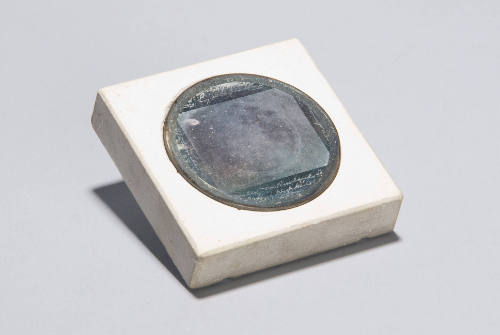


Rowland diffraction grating (replica)
Date1920-1930
Inventory Number2056
ClassificationDiffraction Grating
Subject
Maker
Central Scientific Company
1889 - 2000
Inventor
Robert James Wallace
1868 - 1945
Owner
Theodore Lyman IV
1874 - 1954
User
Department of Physics, Harvard University
founded 1884
Cultural Region
Place of Origin
Dimensions4.5 × 4.5 × 1.2 cm (1 3/4 × 1 3/4 × 1/2 in.)
Container: 8.5 × 6.6 × 2.2 cm (3 3/8 × 2 5/8 × 7/8 in.)
Container: 8.5 × 6.6 × 2.2 cm (3 3/8 × 2 5/8 × 7/8 in.)
Material
Bibliography
DescriptionThis reproduction grating from a Rowland original made on speculum metal is made from a thin processed collodion film which is then mounted on a silvered and polished circular metallic surface and finally mounted on a moulded support. This grating could be used in the usual manner of any other grating. It is divided with 15,160 lines per inch.
The replica slightly smaller than the original, of which part of the engraving is still seen: "[Ru]les on Rowland's En[gine] / Johns Hopkins / [Pl]ate prepared by the [John A. Bra]shear Co.".
The replica slightly smaller than the original, of which part of the engraving is still seen: "[Ru]les on Rowland's En[gine] / Johns Hopkins / [Pl]ate prepared by the [John A. Bra]shear Co.".
Signedon label: Wallace's replica of / Rowland's Grating 15160 lines to the Inch / Central Scientific Co. Chicago, Ill.
Curatorial RemarksWallace perfected this reproduction technique circa 1905.
According to the Cenco catalogue, Wallace's manufacturing technique consisted "in the preparation of a special collodion with which the grating is flowed, producing an exceptionally hard and horny film upon drying. Measured amounts of this solution are used for each cast, and the drying conditions are kept constant and are very slow. The film strips automically [sic] from the original under water, because of the difference in contraction coefficient between the speculum metal and the film. The stripped film is mounted upon selected optical glass of excellent surface, under conditions which assure perfect parallelism between the grating lines, and which the practice of the past twenty years has brought to a high pitch of perfection."
FunctionA diffraction grating is a glass or mirror that has regularly spaced microscopic interruptions to the passage of light (lines) such that light passing through or reflected by it experiences interference phenomena, magnifying its magnitude at some angles and cancelling it at others. As this effect depends on the wavelength of light, a diffraction grating is an effective method of decomposing light into its constituent wavelengths, that will be transmitted at different angles (short wavelengths -- bluer -- are deflected less than longer -- redder -- ones). If one knows the line density (lines per inch) and the angle of deflection (with a spectrometer), one can deduce the exact wavelengths.
Diffraction gratings like this one were often used in astronomy to produce spectra of celestial objects. Begun in 1882, Rowland's gratings were more than an order of magnitude larger and more accurate than any previous one. With these, for instance, it became possible to measure the wavelength of light emitted by atoms to unprecedented accuracy. Rowland himself was able to draw a new and more accurate map of the solar spectrum.
For more information go to the following website.
Diffraction gratings like this one were often used in astronomy to produce spectra of celestial objects. Begun in 1882, Rowland's gratings were more than an order of magnitude larger and more accurate than any previous one. With these, for instance, it became possible to measure the wavelength of light emitted by atoms to unprecedented accuracy. Rowland himself was able to draw a new and more accurate map of the solar spectrum.
For more information go to the following website.
ProvenanceFrom the Department of Physics, Lyman Laboratory, Harvard University.

Central Scientific Company
Date: 1910-1930
Object number: 2059


Henry A. Rowland
Date: circa 1884
Accessories: wooden box; key
Object number: 2031

Sir Thomas Ralph Merton
Date: 1936
Object number: 2054

Central Scientific Company
Date: 1920-1930
Object number: 2057


R. W. Jool
Date: 1910-1920
Object number: 2053


Scientific Shop
Date: 1900-1910
Accessories: Ives' photographic replica of diffraction grating
Ives' photographic replica of circular grating
Object number: WJ0631

