


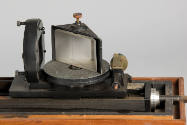


quartz spectrograph
Datecirca 1928
Inventory NumberRS1081
ClassificationSpectrograph
Subject
Maker
Adam Hilger Ltd.
1874 - 1948
Cultural Region
Place of Origin
Dimensions44 x 210.5 x 21.5 cm (17 5/16 x 82 7/8 x 8 7/16 in.)
Material
Accessories3 discoidal feet.
Bibliography
DescriptionThe E1 spectrographs by Adam Hilger are of the "Littrow" form. They are usually large instruments. For this type of instruments, the optical train consists of one quartz lens of 70 mm clear aperture and 170 cm focal length, and a 30 degree prism of quartz 93 to 99 mm length of refracting face X 54 mm high, the second face being coated with tin mercury amalgam, which is a good reflector throughout both the visual and ultraviolet regions. (In 1928, Adam Hilger was experimenting with a platinum coating to replace the tin mercury amalgam.)
The prism and lens are mounted on a carriage which moves along a slide, its position being defined by a scale and index, which can be done when the cover is down. The prism can also be rotated, and its position set by a scale and vernier index. This can only be done when the cover is opened. The positions corresponding with the four portions of the spectrum, and the necessary inclination of the plate, are given in the instructions supplied with each instrument. The slit is a Hilger No. F31. The whole spectrograph is mounted on a substantial cast-iron base.
This type of instrument has a dispersion three times that of the E2, being designed for work with complex spectra, such as that of iron. It takes the entire spectrum from 1930 Å to 8000 Å in four exposures, on 10X4 inch photographic plates.
(Description taken from 1928 trade catalogue)
Original price: 292 £ (in November 1924)
The prism and lens are mounted on a carriage which moves along a slide, its position being defined by a scale and index, which can be done when the cover is down. The prism can also be rotated, and its position set by a scale and vernier index. This can only be done when the cover is opened. The positions corresponding with the four portions of the spectrum, and the necessary inclination of the plate, are given in the instructions supplied with each instrument. The slit is a Hilger No. F31. The whole spectrograph is mounted on a substantial cast-iron base.
This type of instrument has a dispersion three times that of the E2, being designed for work with complex spectra, such as that of iron. It takes the entire spectrum from 1930 Å to 8000 Å in four exposures, on 10X4 inch photographic plates.
(Description taken from 1928 trade catalogue)
Original price: 292 £ (in November 1924)
Signedon instrument: ADAM HILGER LTD / LONDON, ENGLAND. / No E.I.310 / 30301
FunctionHere is how it works. The light enters by the slit, is reflected along the camera tube by a right-angled prism of quartz, is collimated by the lens, enters and is reflected back by the quartz prism, and retraces its path through the lens, an image of the spectrum being formed on the photographic plate. Light, which would be directly reflected on to the photographic plate by the surfaces of lens, thus producing fog and lessening the contrast of the spectrum lines, is removed by insertion before the lens of a strip of brass covered with black velvet. The area of this strip is sufficiently small for no perceptible increase of exposure to be needed. (Description taken verbatim from 1928 trade catalogue)


Adam Hilger Ltd.
Date: 1924-1930
Accessories: Photographic plate holder
Object number: 2005-1-0012a,b

Adam Hilger Ltd.
Date: circa 1930
Object number: 2005-1-0013a

Adam Hilger Ltd.
Date: circa 1920
Object number: 2007-1-0571


Adam Hilger Ltd.
Date: 1924-1928
Object number: 2005-1-0019


Ernst Leitz (company)
Date: circa 1919
Accessories: oculars (2): 3, 8x; accessory box; Leitz objectives (5); wrenches (2); ground glass; N.A. 1.45 condensor cap; Abbe condensor; rotary stage; case
Object number: 1345