


syringe trays
Datecirca 1955
Inventory Number1996-1-0431b
ClassificationInfusion Pump
Subject
Maker
Harvard Apparatus Company
1901-present
User
Raymond Siever
1923 - 2004
Cultural Region
Place of Origin
Dimensionscontroller: 16 × 36 × 17.2 cm (6 5/16 × 14 3/16 × 6 3/4 in.)
box of accessories: 6.5 × 30 × 18 cm (2 9/16 × 11 13/16 × 7 1/16 in.)
box of accessories: 6.5 × 30 × 18 cm (2 9/16 × 11 13/16 × 7 1/16 in.)
Material
Description(b) tube/syringe trays (4) that go with the syringe injection controller (a).
(a) is a blue rectangular box oriented horizontally. In the bottom left corner is the name plate bearing the instrument's name, model number, maker, and serial number. Above the nameplate is a white switch, on top of which is written "NO". On this side, on the top of the box, is a black dial and the origin of a black power cable. The middle of the box, on the front side, has a scale running underneath it; the scale ranges from "1" on the right to "30" on the left, in single unit intervals.
The number 20 is colored in orange by the user. Immediately above this scale is a shaft; a small gray cylinder mounted on the end of a small rod slides back and forth, allowing a fine black line down its center to line up with one of the numbers.
Above this adjustable setting is another more complicated one. Another scale, this one much thicker ranges, from left to right, from 40 to 0 to 50, in intervals of 10. This scale, however, is quite thick. Another horizontal shaft is above this scale. A long, thick, vertical, bar marks the setting here, and it is set in place by a black dial found perpendicular to and behind it.
On the right hand side of this device is where the 'tray' gets plugged in at each of its four corners. Each tray features four (or in one case three) fixed sets of placeholders meant to keep a tube or syringe in place. Below the tray is a notation of the user in black marker: ".21ml/unit".
(a) is a blue rectangular box oriented horizontally. In the bottom left corner is the name plate bearing the instrument's name, model number, maker, and serial number. Above the nameplate is a white switch, on top of which is written "NO". On this side, on the top of the box, is a black dial and the origin of a black power cable. The middle of the box, on the front side, has a scale running underneath it; the scale ranges from "1" on the right to "30" on the left, in single unit intervals.
The number 20 is colored in orange by the user. Immediately above this scale is a shaft; a small gray cylinder mounted on the end of a small rod slides back and forth, allowing a fine black line down its center to line up with one of the numbers.
Above this adjustable setting is another more complicated one. Another scale, this one much thicker ranges, from left to right, from 40 to 0 to 50, in intervals of 10. This scale, however, is quite thick. Another horizontal shaft is above this scale. A long, thick, vertical, bar marks the setting here, and it is set in place by a black dial found perpendicular to and behind it.
On the right hand side of this device is where the 'tray' gets plugged in at each of its four corners. Each tray features four (or in one case three) fixed sets of placeholders meant to keep a tube or syringe in place. Below the tray is a notation of the user in black marker: ".21ml/unit".
Signedon nameplate in bottom left corner: HARVARD APPARATUS CO., INC. / DOVER, MASS.
Inscribedon nameplate in bottom left corner: COMPACT INFUSION PUMP / MODEL NO. 977 / SERIAL NUMBER _101_
Curatorial RemarksInstrument found dismantled on shelf. Was put back together by R. Wright, hence, screws holding internal parts to box are not original.
FunctionAn infusion pump allows its user to regulate the flow of fluids. A given fluid, contained in a syringe would be mounted on the bracket, allowing the pump to push down on the plunger at a given measurable rate.
Although one might assume infusion pumps such as this one belong in a hospital --
infusing fluids, medication or nutrients into a patient's circulatory system -- this one seems to have been used by Prof. Raymond Siever in his geological scholarship. Siever was a noted geochemist (he actively participated in the International Geochemical Society) who studied silica in near-surface environments.
Although one might assume infusion pumps such as this one belong in a hospital --
infusing fluids, medication or nutrients into a patient's circulatory system -- this one seems to have been used by Prof. Raymond Siever in his geological scholarship. Siever was a noted geochemist (he actively participated in the International Geochemical Society) who studied silica in near-surface environments.
Historical AttributesProf. Ray Siever, Geology, 2 June 1989

Harvard Apparatus Company
Date: circa 1955
Accessories: tube/syringe trays x4 (b); piece of plastic
Object number: 1996-1-0431a

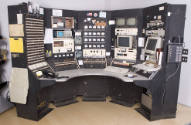
Harvard Cyclotron Laboratory
Date: 1947-2002
Object number: 2003-1-0291


Sterling P. Fergusson
Date: 1931
Object number: 1998-1-1051b

Crosby Steam Gage & Valve Company
Date: circa 1903
Accessories: instruction manual; letter from company; one gallon can of oil (2002-1-0100)
Object number: 1998-1-1618

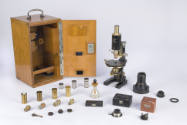
Carl Zeiss, Optische Werkstätte, Jena
Date: circa 1902
Accessories: oculars (5); objectives (5); microplanar objectives (2); iris diaphragm; abbe condenser; collars and sleeves for photography; parts box; Leitz object micrometer (1308b); cardioid condenser (1308d); immersion oil bottle (1308c) ; Leitz erecting prism (1308e); standing case with key
Object number: 1308a


General Electric Company
Date: circa 1956
Accessories: envelope containing instruction book and a mimeograph of a letter suggesting corrections
Object number: 2004-1-0383