


vacuum tube bridge
Datecirca 1959
Inventory Number1998-1-1619a
ClassificationVacuum Tube
Subject
Maker
General Radio Company
1915-present
User
Cruft Laboratory, Harvard University
founded 1914
Cultural Region
Place of Origin
Dimensions37.5 × 40 × 46.5 cm (14 3/4 × 15 3/4 × 18 5/16 in.)
Material
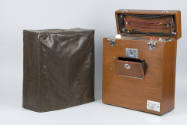
DescriptionThis apparatus consists of a wooden box enclosed by a black face; the back of the box is taller than the front, so the face itself is angled up toward the viewer.
The four sides of the box are made of wood, in spots slightly scratched or dirty, with two thin decorative grooves running parallel near the bottom. On the front and left sides of the base is painted in yellow block letters 'CRUFT'. ('CRUFT' was also apparently painted on the bottom left corner of the face but has since mostly worn off.)
Along each sides of the black face of this apparatus are three small black slotted knobs, presumably covering the heads of the screws affixing the face to the body.
The top half of the face is largely covered in various types of emanating wires and sockets. Thin, elevated circular sockets run from the middle of the left side, along the top, and a sixth of the way down the right side. Of the two dozen or so sockets, five are made of red plastic (and are presumably replacement sockets), and the rest are made of metal. Immediately underneath the bottom socket on the right side is a small switch. Underneath the top line of sockets are two rows, each with eight circular holes. They are labeled both individually (for example, E-4), as well as in groups of four or six (for example, control grids). Underneath the bottom row of holes, horizontally centered, is a larger circular hole, with a ring of nine sockets (most likely to position a vacuum tube). The hole is flanked by four emerging wires that are thick and black. Each of these wires terminates with a thin, long plug that fit into the labeled circular holes above.
The bottom half of the face is largely covered in knobs of different sizes. Each of the twelve knobs is black, and has a label and a scale. Some of these scales are marked with numbers (for example, the 'HUNDREDS', 'TENS', and 'UNITS' knobs range from 0 to 10, and the 'MULTIPLY BY' and 'DIVIDE BY' knobs have increments of powers of 10) and some are marked with words (for example, the 'TUBE SECTION' knob can be turned to 'SECT I' or 'SECT II'). The types of knobs vary as well; some have white dots to indicate the setting, some have attached triangles.
The four sides of the box are made of wood, in spots slightly scratched or dirty, with two thin decorative grooves running parallel near the bottom. On the front and left sides of the base is painted in yellow block letters 'CRUFT'. ('CRUFT' was also apparently painted on the bottom left corner of the face but has since mostly worn off.)
Along each sides of the black face of this apparatus are three small black slotted knobs, presumably covering the heads of the screws affixing the face to the body.
The top half of the face is largely covered in various types of emanating wires and sockets. Thin, elevated circular sockets run from the middle of the left side, along the top, and a sixth of the way down the right side. Of the two dozen or so sockets, five are made of red plastic (and are presumably replacement sockets), and the rest are made of metal. Immediately underneath the bottom socket on the right side is a small switch. Underneath the top line of sockets are two rows, each with eight circular holes. They are labeled both individually (for example, E-4), as well as in groups of four or six (for example, control grids). Underneath the bottom row of holes, horizontally centered, is a larger circular hole, with a ring of nine sockets (most likely to position a vacuum tube). The hole is flanked by four emerging wires that are thick and black. Each of these wires terminates with a thin, long plug that fit into the labeled circular holes above.
The bottom half of the face is largely covered in knobs of different sizes. Each of the twelve knobs is black, and has a label and a scale. Some of these scales are marked with numbers (for example, the 'HUNDREDS', 'TENS', and 'UNITS' knobs range from 0 to 10, and the 'MULTIPLY BY' and 'DIVIDE BY' knobs have increments of powers of 10) and some are marked with words (for example, the 'TUBE SECTION' knob can be turned to 'SECT I' or 'SECT II'). The types of knobs vary as well; some have white dots to indicate the setting, some have attached triangles.
Signedin the center of the face, in white lettering: GENERAL RADIO CO. / CAMBRIDGE MASS., U.S.A.
Inscribedin the center of the face, in white lettering: VACUUM-TUBE BRIDGE / TYPE NUMBER SERIAL NUMBER / 1661-A 102
FunctionThe purpose of the vacuum tube bridge was as a "tube-testing device". The device, consisting of a series of meters and rheostats, was designed to check filament power and to measure certain characteristics of tubes such as plate voltage and DC grid bias.
ProvenanceCruft Laboratory, Department of Physics, Harvard University; transferred to CHSI July 10, 1998 via Francis "Deke" De Costa.

Date: 1890-1930
Object number: RS0505


Hammond Typewriter Company
Date: circa 1923
Accessories: four Hammond type shuttles for different type faces, each with a wooden storage box; four laminated paper rectangles with symbol placement guide; instruction book, instruction sheets, advertisements, and correspondence (in object file)
Object number: 1996-1-0373


George Washington Pierce
Date: circa 1926
Accessories: 8 batteries (removed during FAE inventory).
Object number: RS1275

J. W. Fecker, Inc.
Date: circa 1933
Object number: 2015-1-0013


Thomas de Colmar
Date: circa 1860
Accessories: two instruction books (in French) dated 1856, 1860; explanatory article by F. Reuleaux (in German) dated 1892
Object number: 1990-5-0026

Date: 1890-1930
Object number: RS0501
Sanborn Company
Date: 1930-1945
Accessories: leather cover; cloth cover; thin red wire
Object number: 1996-1-0278

Andrew Pritchard
Date: 1835-1840
Accessories: objectives (4); oculars (6); lieberkühns (4); stage forceps; bull's eye condenser on stand; spring stage; extra mechanical stage; polarizer; cup diaphragms and holders; substage fork mount; live box; glass troughs (2); concave glass; fish tube holder; case; 2 keys. See also slide micrometers (2) (1088b,c)
Object number: 1088a
See also/See also
