


Aubert's episcotister
Datecirca 1900
Inventory NumberWJ0204
ClassificationEpiscotister
Subject
Inventor
Hermann R. Aubert
1826 - 1892
Maker
German
?
Cultural Region
Place of Use
Dimensions14 × 10.5 × 4.5 cm (5 1/2 × 4 1/8 × 1 3/4 in.)
Material
DescriptionCalibrated metal disk coaxial with another disk with two wedges cut out.
The disc is supported by a square fork. From bottom to top, the fork consists of a hexagonal piece supporting a copper-colored disk, which in turn is supporting a pillar that screws into a block. To each side of this block is fastened an arm tapering toward the bearing. The axle running through the bearing supports the wheel as well as two other coaxial wheels. One of those wheels is a ridged disc between the wheel and the bearing. The other is a brass pulley wheel on the other side of the bearing. The cable slot in this wheel is tinged with green corrosion.
The wheel itself is compound. One part of it is a circle with two 90-degree wedges cut out opposite each other from the center. The other wheel is similar in shape, but one side of it is calibrated in degrees from 0 to 90 and numbered at every tenth degree. The scale is divided by tick marks at every degree of arc. This wheel appears to be copper colored.
The disc is supported by a square fork. From bottom to top, the fork consists of a hexagonal piece supporting a copper-colored disk, which in turn is supporting a pillar that screws into a block. To each side of this block is fastened an arm tapering toward the bearing. The axle running through the bearing supports the wheel as well as two other coaxial wheels. One of those wheels is a ridged disc between the wheel and the bearing. The other is a brass pulley wheel on the other side of the bearing. The cable slot in this wheel is tinged with green corrosion.
The wheel itself is compound. One part of it is a circle with two 90-degree wedges cut out opposite each other from the center. The other wheel is similar in shape, but one side of it is calibrated in degrees from 0 to 90 and numbered at every tenth degree. The scale is divided by tick marks at every degree of arc. This wheel appears to be copper colored.
Signedunsigned
FunctionAccording to Stoelting's catalog, Psychological and Physiological Apparatus and Supplies (1930), this apparatus is used for "varying the intensity of the illumination from a source of light" (25, no. 12801). The width of the openings can be varied by rotating one of the discs relative to the other along the rotational scale. "The circle may be operated by means of a cord, and the end of the axle is also supplied with a small grooved pulley to permit operation by a small motor" (25, no. 12801).
This device was also used to perform experiments on the perception of transparency. According to Fabio Metelli's article "The Perception of Transparency," Scientific American 230(4), the episcotister "generates a strong impression of transparency when it is rotated at high speed. This technique enables the experimenter to independently vary the size of the missing sectors (which affects the degree of transparency) and the color of the remaining sectors (which determines the color of the transparent layer)" (92).
This device was also used to perform experiments on the perception of transparency. According to Fabio Metelli's article "The Perception of Transparency," Scientific American 230(4), the episcotister "generates a strong impression of transparency when it is rotated at high speed. This technique enables the experimenter to independently vary the size of the missing sectors (which affects the degree of transparency) and the color of the remaining sectors (which determines the color of the transparent layer)" (92).
ProvenanceDepartment of Psychology, Harvard University.

French
Date: circa 1890
Accessories: Leyden jars (2)
2 rubber pulley belts
Object number: DW0890
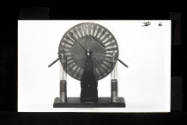


Ballou Manufacturing Company
Date: 1880-1890
Object number: 1997-1-0515


Central Scientific Company
Date: circa 1940
Accessories: 2 Leyden condensers made of Pyrex
One rubber **gutta percha?** pulley, rotted.
Object number: 1997-1-0634
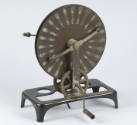


Jakob Amsler
Date: circa 1906
Accessories: instrument is in four (4) parts; the rail is in own box and is inventory # 2006-1-0002b; letter from Prof. William Brower containing the complete history of ownership and use (missing)
Object number: 2006-1-0002a
